Open Calls
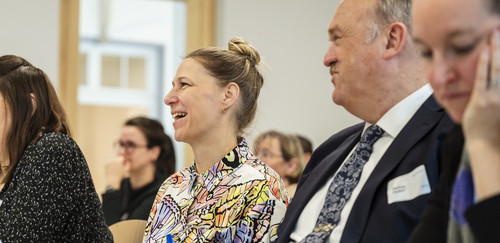
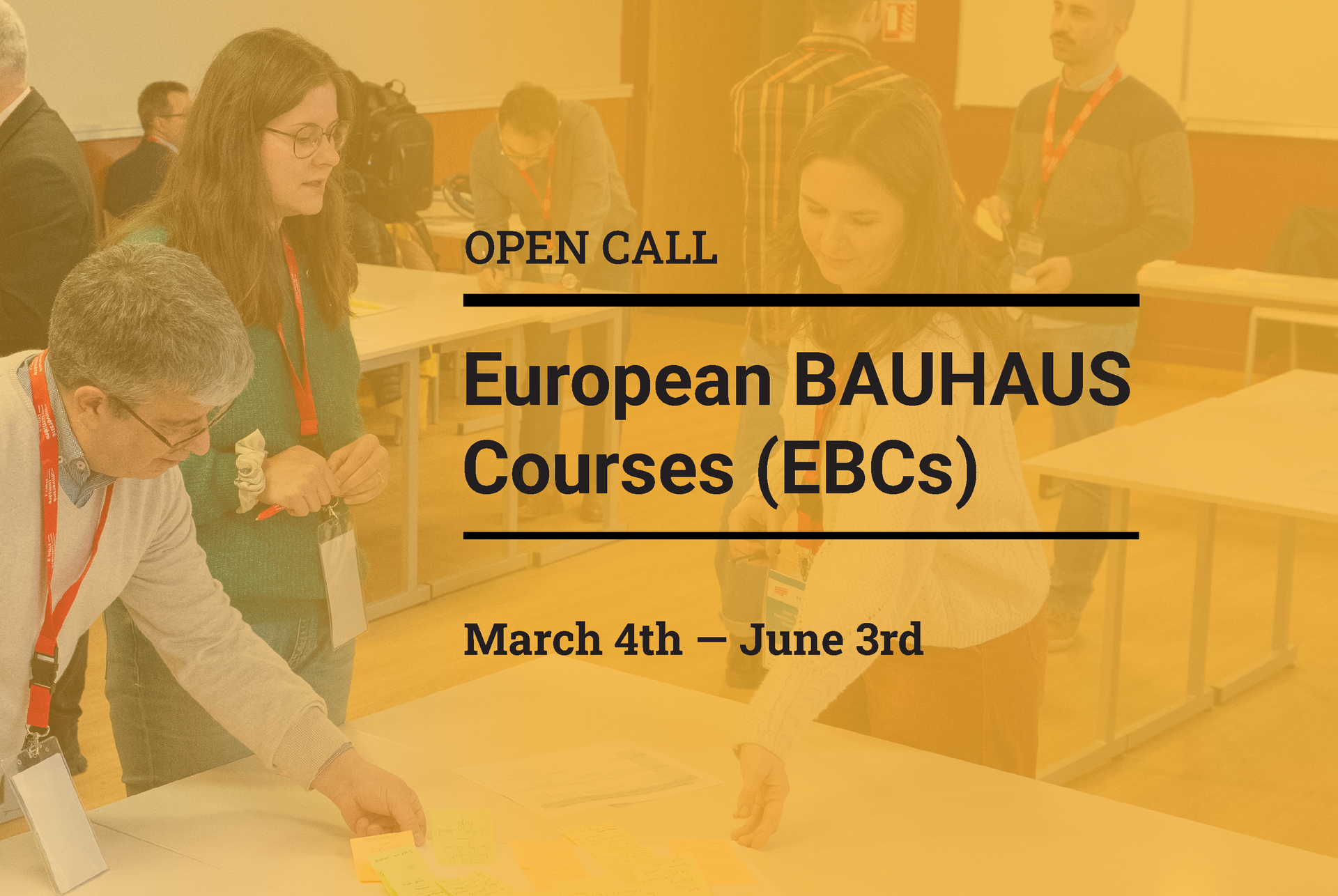
The BAUHAUS4EU European University Alliance invites academic staff from all partner institutions to submit proposals for European BAUHAUS Courses (EBC) – innovative, interdisciplinary and challenge-based learning formats inspired by the principles of the New European Bauhaus (NEB) Initiative.
Key facts:
| What | Open Call for creation of joint, interdisciplinary courses with focus on New European Bauhaus Themes |
| Submission deadline | 3 June 2026 |
| Eligibility | Teaching staff from all full partner institutions of BAUHAUS4EU |
| Accepted course formats | Blended Intensive Programme (BIP), Collaborative Online International Learning (COIL), Hackathon |
| More information |
|
| Match-making event | Find your international partner to create courses with! More info down below. |
| Contact & support | Download full open call document |
| Application Form | Submit here |
Why apply?
European BAUHAUS Courses enable teaching staff to develop innovative joint courses with European partners, increase the international visibility of their discipline, collaborate with external stakeholders, and contribute to transformative learning connected to the growing New European Bauhaus community.
European BAUHAUS Courses offer teaching staff a unique opportunity to:
- develop innovative, challenge-based and interdisciplinary teaching formats in collaboration with European partner universities,
- make their fields of study visible and attractive to an international student audience,
- engage with real-world transformation challenges,
- build lasting academic and practice-oriented partnerships across the Alliance,
- benefit from organisational support, mobility opportunities (BIP), and alliance-wide dissemination,
- benefit from a growing interdisciplinary New European Bauhaus community and links to the NEB Facility,
- contribute to the long-term integration of joint European teaching formats into institutional curricula.
Join the info webinar on March 30, 12h-13h CET!
Submit your idea
Register for the EBC Match-Making Event!
Find your academic B4EU-partner for the creation of European BAUHAUS Courses! The match-making is taking place in a series of online sessions from 23 March to 18 May.
Sign up for the online inter-university match-making events here!
Sessions:
- Monday 23 March, 2:00-3:00 pm (Link to the call): Dedicated session for professors
- Monday 30 March, 2:00-3:00 pm (Link to the call): Dedicated session for professors
- Tuesday 14 April, 10:00-11:00 am (Link to the call): Dedicated session for stakeholders
- Monday 20 April, 2:00-3:00 pm (Link to the call): Dedicated session for stakeholders
- Monday 18 May, 2:00-3:00 pm (Link to the call): Open session
Download Full Call Paper
The BAUHAUS4EU European University Alliance invites academic staff from all partner institutions to submit proposals for Regional Living Labs (RLLs). RLLs are open innovation ecosystems aligned with the New European Bauhaus (NEB) vision and core values. They connect universities, students, local communities, and regional stakeholders to collaboratively design, test, and implement sustainable and inclusive project ideas addressing place-based challenges.
Key facts:
| What | Open Call for creation of joint, interdisciplinary courses with focus on New European Bauhaus Themes |
| Submission deadline | 3 June 2026 |
| Funding | Each Regional Living Lab may receive funding of up to €10,000 to support its development and implementation |
| Eligibility | Teaching staff from partner universities within the BAUHAUS4EU consortium, working with an interdisciplinary approach. |
| More information |
|
| Contact & support | Download full open call document |
| Application Form | Submit here |
Objective of the call:
Regional Living Labs operate as experimental learning environments, encouraging interdisciplinary teaching formats and collaboration across faculties to engage students from diverse academic backgrounds. Learning activities are embedded in real regional contexts and developed in close interaction with local actors, social environments, and community knowledge. Ideally, RLLs may focus on the revitalisation, reuse, and transformation of unused or vacant built and unbuilt spaces in both urban and rural contexts.
Why apply?
Selected teaching staff will be supported by the BAUHAUS4EU Alliance in the development and implementation of the Regional Living Labs through the following activities:
- A pedagogical support course on interdisciplinary course development.
- A community of practice of BAUHAUS4EU members.
- Three online workshops (kick-off, mid-term, and closing) with selected regional partners of the alliance, on the involvement of local communities, place-based design of labs, and communication with local and regional stakeholders.
Join the info webinar on March 27, 12h-13h CET!
Click here to register: https://events.teams.microsoft.com/event/d070383a-4cc0-480c-a9e7-cb7d7bfc432a@a51a6642-5911-4306-a13c-f4731ab9c63f
Submit your idea
Download Full Call Paper
Past Calls
Under the title “Politics of Research” the XV. International Bauhaus Colloquium invites researchers from across different discourses and geographies to critically examine the politics that underlie, shape, or result from research. As an interdisciplinary academic event, it aims to create a platform for exploring how research deals with power relations, institutional structures, funding systems, epistemologies, socio-cultural contexts, and dynamic publics. Politics of research manifest themselves on the level of specific research projects as well as on the level of procedures and frameworks as such.”
Open Calls:
Call for Papers:
- Paper proposals should include an abstract of no more than 450 words. Please add a maximum of 5 key references and 3–5 keywords that best describe your proposal.
- Presentations consist of 20-minute slots, followed by 10 minutes of Q&A.
Call for Panels:
- Panel proposals should include a session description of no more than 450 words and additional abstracts on each participant’s contribution (maximum 250 words). Please add a maximum of 7 key references for the panel’s approach and 5–7 keywords that best describe your proposal.
- Panels consist of a 120-minute slot, which should leave time for Q&A’s or other forms of audience engagement. Panel size may vary, depending on your particular approach. An average size of 3–4 participants is recommended. Diversity across institutions, disciplines, career stage, and gender is strongly encouraged.
Call for Formats:
- Proposals of artwork, installations, exhibitions, prototypes, performances, data visualizations, demonstrations, tutorials, workshops, etc. should include an abstract (max. 1000 words), explaining the relevance of the proposed format to the Colloquium’s theme.
- Please include equipment, space, and technical requirements, as well as the expected duration. If you submit an artwork, prototype, or any other visual contribution, please include photographs or drawings of the work submitted if possible and applicable.
Application Procedure
Biographical Information:
Along with your abstract, please provide a brief biographical note (maximum 100 words) including your institutional affiliation, main research interests, and — if applicable — your most recent publications or exhibitions.
Submission Format:
The conference will be held in English. Submissions are accepted in English only. Please send your proposals as a single PDF document to ibhk2026[at]uni-weimar.de
Deadline for Submission:
All proposals must be submitted by 15 December 2025 (23:59 CET).
Notification of Acceptance:
Applicants will be notified of acceptance by the end of January 2026.
Registration fee:
A registration fee of 50€ may apply, subject to confirmation of conference funding.
Download Full Call for Contributions

Stay Tuned!
Listen to our BAUHAUS4EU Podcast and sign up for our newsletter – stay up to date on all of our ongoing developments and planned activities!
Download Area
In the Download Area, you can find our communication kit, logos, deliverables and other useful documents.