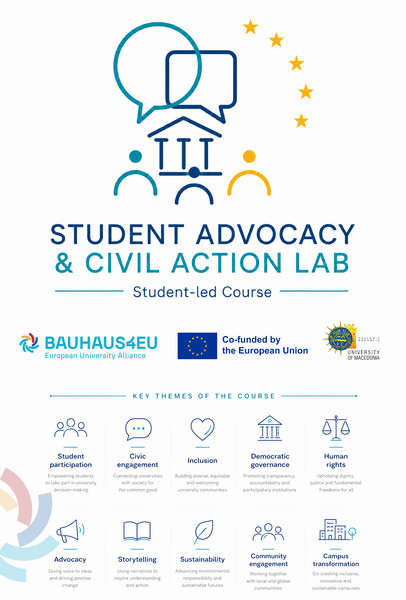
Student Advocacy and Civil Action Lab
Course Title
Student Advocacy and Civil Action Lab
Course Description of Student-Led Course
The course explores universities as democratic, inclusive, and participatory communities where students actively contribute to institutional and social transformation. It focuses on student advocacy, civic participation, inclusion, democratic engagement, participatory governance, and collaboration between universities, civil society organisations, and local communities. It examines European and international frameworks related to human rights, fundamental freedoms and European values, including democratic citizenship, accessibility, inclusion, equality, and youth participation. Particular attention is given to the experiences and representation of vulnerable and underrepresented student groups.
Students will engage in participatory research, storytelling methods, collaborative workshops, and community-based activities in cooperation with NGOs and local actors. Through these activities, participants will develop practical skills in advocacy, partnership-building, institutional dialogue, and inclusive civic action.
The course contributes to the transformation of BAUHAUS4EU universities into more inclusive, participatory, and socially sustainable campuses by empowering students to actively engage in institutional and community life by promoting democratic participation, accessibility, equality, wellbeing, and social inclusion through collaborative learning, participatory research, and civic engagement practices. By encouraging students to identify barriers to participation and co-create solutions together with local communities, NGOs, and university stakeholders, the course supports more inclusive and resilient university environments.
In addition, the course contributes to the social dimension of sustainability by strengthening community participation, institutional accountability, and democratic governance within higher education institutions.
Through participatory research projects, storytelling activities, and civic action initiatives, students develop practical proposals that can improve campus inclusiveness, student wellbeing, accessibility, and community engagement.
Furthermore, the course reflects the NEB working principles of participatory process, transdisciplinary collaboration, and multi-level engagement by encouraging cooperation between students from different disciplines, civil society organisations, local actors, and university institutions. By combining co-creation, democratic participation, interdisciplinary collaboration, and community-centered innovation, the course encourages students to become active contributors to institutional transformation and to the development of socially sustainable and inclusive university communities.
Learning Outcomes
After successfully completing the course, students will be able to:
• critically evaluate democratic participation and inclusion processes within higher education institutions;
• analyse European and international frameworks concerning human rights, student participation, inclusion,
and civic engagement;
• identify barriers affecting vulnerable and underrepresented groups within university communities;
• conduct participatory and collaborative research on issues related to inclusion, accessibility, and civic
participation;
• develop evidence-based advocacy strategies and institutional policy proposals;
• collaborate effectively with students from different disciplines, NGOs, and local community actors;
• apply participatory storytelling and narrative methods to explore lived experiences connected to inclusion
and civic engagement;
• design and present civic action initiatives that contribute to more inclusive and socially sustainable university
communities.
The learning outcomes align with the New European Bauhaus values of inclusivity, participation, sustainability, and co-creation, as well as with the United Nations Sustainable Development Goals, particularly SDG 4, SDG 10, SDG 11, SDG 16, and SDG 17. The course is also closely aligned with the principles and working methods of the New European Bauhaus Compass. In particular, it supports the NEB values of “Together” and “Beautiful” by fostering inclusive participation, a sense of belonging, collective engagement, and meaningful social interaction within university communities.
Prerequisites for the Course
No
Registration Info and Deadline
Only UOM students can apply. Information on registration will be communicated internally.
At a Glance
| Where | University of Macedonia |
| Name of lecturer(s) | Athanasios Stathopoulos |
| Open for students from faculties/degree programmes | All faculties/schools/departments |
| Time period | |
| Year | All |
| Planned format | Seminar |
| Required study level(s) | Bachelor |
| ECTS | 3 |
| Registration info and deadline | Only UOM students can apply. Information on registration will be communicated internally. |
| Max. number of participants | |
| Contact person | bauhaus4eu[at]uom.edu.gr |
Stay Tuned!
Listen to our BAUHAUS4EU Podcast and sign up for our newsletter – stay up to date on all of our ongoing developments and planned activities!
Download Area
In the Download Area, you can find our communication kit, logos, deliverables and other useful documents.