FIRESCAPE
Course Title
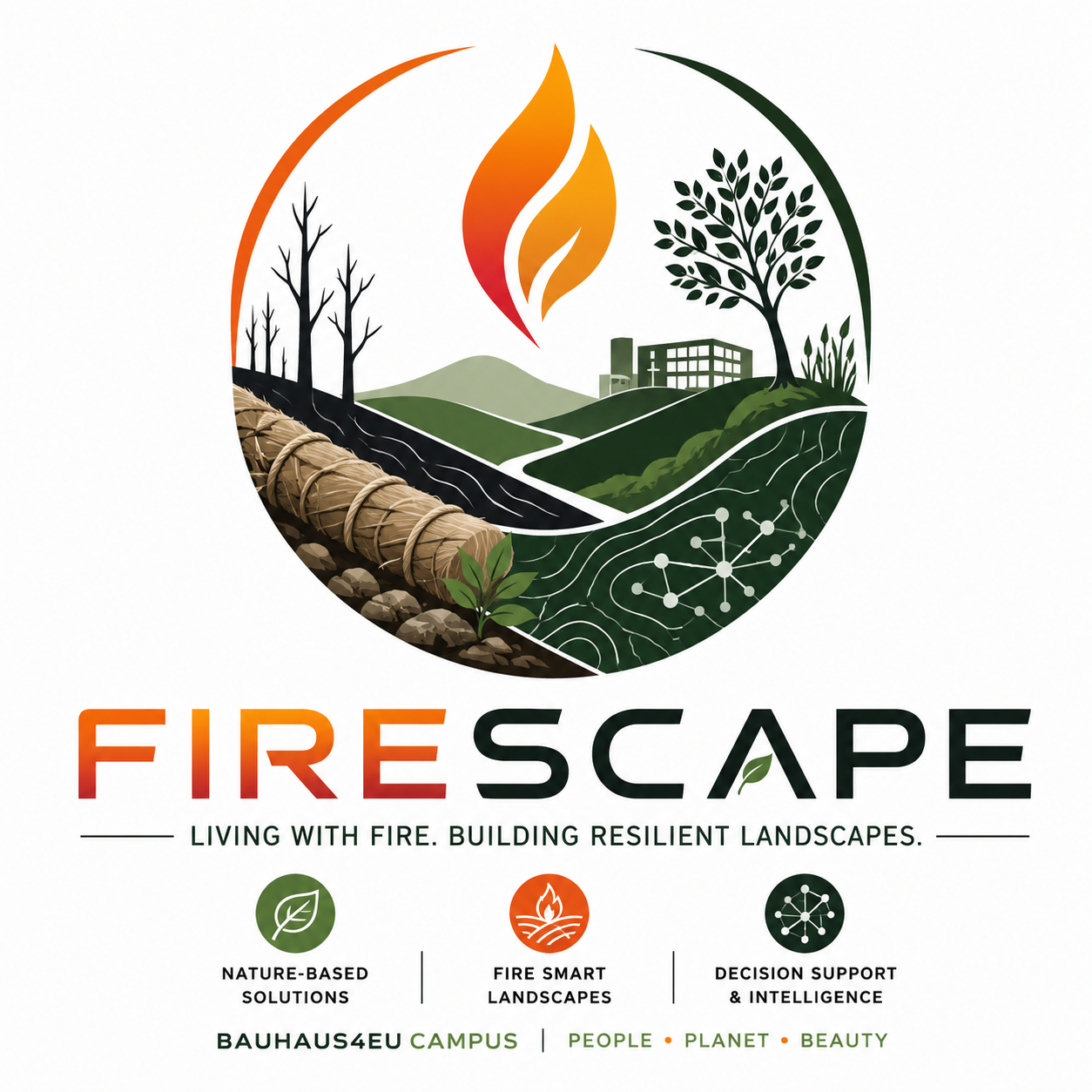
FIRESCAPE – Living with Fire, Designing Resilient Landscapes
Course Description of Student-Led Course
This project module is centered on designing resilient landscapes and communities in regions increasingly vulnerable to rural fires and climate change. It adopts the university campus and its surrounding territory as a living laboratory where students explore nature-based solutions, climate adaptation, and regenerative design. A defining feature of the course is its practical focus on circular resource use, particularly the application of raw sheep wool - a locally available natural material - for post-fire soil protection and sediment stabilisation. These nature-based erosion control projects improve ecological resilience while promoting environmental awareness within the community. By using materials like raw sheep wool, the project links environmental restoration with regional knowledge and territorial identity, ensuring sustainability is culturally meaningful.
Upon completion, students will be able to explain the relationship between climate change and landscape vulnerability and co-design evidence-based interventions. Final outputs include a collaborative project proposal, visual communication materials such as StoryMaps and dashboards, and, where technically feasible, demonstrative physical prototypes. It connects environmental and forestry sciences for post-fire impacts, landscape and territorial planning for spatial design, and Geographic Information Systems (GIS) for territorial diagnosis. It further integrates principles of circular economy and design for material experimentation, alongside communication and sociology for community engagement. Students work in mixed teams to ensure that different disciplinary intuitions—such as technical feasibility, structural precision, and ecological understanding—converge to solve real-world challenges.
This interdisciplinary structure is mirrored in the teaching team, which includes a PhD student lead in Agro-Food and Environmental Sustainability, mentors in Natural Resources, and external experts in wildfire analysis and climate research. The curriculum moves from introductory thematic sessions to hands-on field observation, participatory diagnosis, and interdisciplinary design workshops. This structure ensures that students transition from knowledge acquisition to the implementation of practical, evidence-based solutions that address real territorial risks.
Learning Outcomes
Upon successful completion of the FIRESCAPE module, students will have acquired both theoretical knowledge and practical design skills. Specifically, they will be able to explain the complex relationships between climate change, rural fire risk, landscape vulnerability, and the resilience of local communities. Using the university campus as a case study, students will learn to identify environmental and social challenges within fire-prone territories. They will also possess the analytical capacity to evaluate the potential of nature-based solutions and circular materials—with a particular focus on the application of raw sheep wool—for post-fire restoration and climate adaptation.
In terms of practical application, students will be able to co-design interdisciplinary, feasible, and visually meaningful interventions or prototypes aimed at creating a greener and more resilient campus. Because the module emphasises collaboration, students will demonstrate the ability to work effectively in mixed teams with peers from different academic backgrounds and communicate their results to both academic and non-academic audiences. Furthermore, students will be equipped to critically assess how the integration of local resources, territorial identity, and participatory design processes can contribute to long-term sustainable transformation. These learning outcomes are deeply integrated with the three core values of the New European Bauhaus Compass. The course addresses sustainability by developing environmentally responsible solutions for landscape recovery. It fosters inclusion through a collaborative participatory process that involves students from all faculties, academic mentors, and external territorial partners.
Finally, it emphasises beauty by prioritising landscape quality and the public visibility of technical interventions, ensuring they are aesthetically integrated into the campus environment.Additionally, the course outcomes contribute directly to five United Nations Sustainable Development Goals. Through its challenge-based and project-based methodology, it supports SDG 4 (Quality Education). By training students to design climate-resilient campus infrastructure, it aligns with SDG 11 (Sustainable Cities and Communities). The practical experimentation with circular materials like raw sheep wool addresses SDG 12 (Responsible Consumption and Production). Furthermore, the project’s focus on landscape-level fire resilience and restoration provides tangible contributions to SDG 13 (Climate Action) and SDG 15 (Life on Land). By the end of the module, students will have moved from passive acquisition of knowledge to active, interdisciplinary co-creation for institutional and territorial change.
Prerequisites for the Course
No
Registration Info and Deadline
Registration until October 9, 2026 here. Only UPCB students can apply.
At a Glance
| Where | Polytechnic University of Castelo Branco |
| Name of lecturer(s) | Daniel Santana |
| Open for students from faculties/degree programmes | All faculties/schools/departments |
| Time period | Winter semester 2026/2027 |
| Year | All |
| Planned format | Project module |
| Required study level(s) | All study levels |
| ECTS | 3 ECTS |
| Registration info and deadline | Registration until October 16, 2026 here. Only UPCB students can apply. |
| Max. number of participants | 25 |
| Contact person | b4eu[at]ipcb.pt |
Stay Tuned!
Listen to our BAUHAUS4EU Podcast and sign up for our newsletter – stay up to date on all of our ongoing developments and planned activities!
Download Area
In the Download Area, you can find our communication kit, logos, deliverables and other useful documents.