Design Thinking in Civil Protection
Course Title
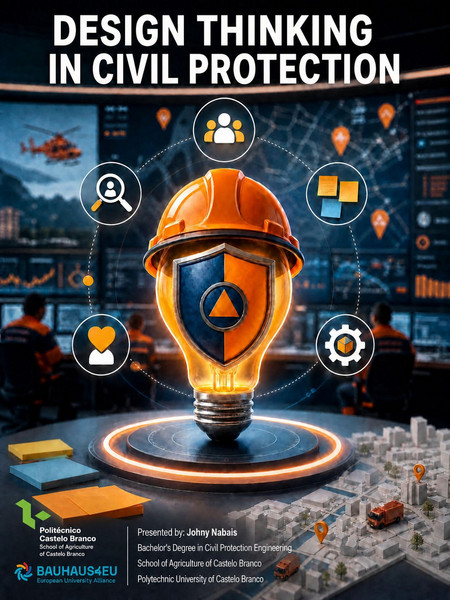
Design Thinking in Civil Protection: Innovating Campus Resilience Through Interdisciplinary Co-Creation
Course Description of Student-Led Course
This course applies human-centered Design Thinking methodologies to traditional Civil Protection challenges, using the university campus as a primary testing ground. Organized into interdisciplinary teams, students analyse existing risks, identify local vulnerabilities, and develop practical, prototyped solutions to transform the campus into a more resilient and sustainable environment.The course contributes significantly to green and inclusive campus transformation by integrating the three pillars of the New European Bauhaus. It promotes sustainability through the use of circular and low-impact materials in safety designs. Inclusion is addressed through accessible design that considers all students, while beauty is incorporated by reinventing safety spaces, such as emergency meeting points, to be welcoming environments that inspire confidence rather than fear. This approach shifts campus safety from a prescriptive, top-down process to one of shared governance and community participation.
The expected impact of the course is the development of a "Resilient Campus" model. Key outcomes include a better-prepared community with higher risk literacy, the creation of reinvented safety hubs that are well-signposted and equipped, and the deployment of adaptive physical and digital infrastructures. Furthermore, the course aims to produce open documentation of best practices. After successful completion, students will be able to lead transformation processes and communicate complex risks and solutions clearly to diverse stakeholder. The approach is inherently interdisciplinary because Civil Protection requires knowledge from diverse fields such as engineering for infrastructure, psychology for crisis management, communication for alerts, design for signage, and sociology for understanding mass behavior. By forming teams with students from all academic backgrounds, the course stimulates peer-learning and ensures multiple perspectives are represented in the problem-solving process.
This interdisciplinary structure is delivered through a pedagogical design based on project-based and experiential learning, including field visits, simulations, and gamification through "innovation sprints". The workload of 75 hours (3 ECTS) allows for a structured co-creation process, moving from initial risk identification to iterative prototype testing with real users to ensure solutions are both practical and community-validated.
Learning Outcomes
Upon successful completion of the Design Thinking in Civil Protection module, students will be able to apply human-centred Design Thinking methodologies to solve real-world community safety and resilience problems. They will know how to identify and analyse specific risks and vulnerabilities within urban and educational contexts, using the university campus as their primary living laboratory. Beyond theoretical understanding, students will be capable of developing innovative, sustainable, and inclusive solutions for emergency management. A core practical outcome is the ability to prototype and iteratively test these concepts with real users, ensuring that solutions are both functional and community-validated.
Furthermore, students will have developed the skills to work effectively in interdisciplinary teams, communicate complex risks and solutions clearly to diverse stakeholders, and lead institutional change and transformation processes on campus. These learning outcomes are deeply integrated with the three core values of the New European Bauhaus Compass. The course addresses sustainability by prioritising the use of circular and low-impact materials in the development of safety infrastructures. It fosters inclusion through a commitment to universal and accessible design that considers the needs of all students and staff. Finally, it emphasises beauty by reinventing traditionally sterile safety spaces—such as emergency meeting points—into welcoming environments that inspire confidence and well-being rather than fear.
This approach aligns with NEB working principles by promoting shared governance and participatory processes in campus security management. Regarding the United Nations Sustainable Development Goals, the module contributes most significantly to the creation of sustainable and safe communities. By increasing risk literacy and responsiveness among the campus population, the course directly supports targets related to disaster risk reduction and resilient infrastructure. The emphasis on resource-conscious safety designs and the use of circular materials further aligns with goals regarding responsible consumption and production. Ultimately, by the end of the course, students transition from being passive observers of security policies to active co-creators of a more resilient, inclusive, and sustainable university ecosystem.
Prerequisites for the Course
No
Registration Info and Deadline
Registration until October 9, 2026 here. Only UPCB students can apply.
Course dates: October 15, 2026 to December 10, 2026. Classes will take place every Thursday, from 2:00 p.m. to 6:00 p.m.
Note: Class times may be adjusted or changed depending on the availability of the students, the trainer, or the classrooms.
At a Glance
| Where | Polytechnic University of Castelo Branco |
| Name of lecturer(s) | Johny Nabais |
| Open for students from faculties/degree programmes | All faculties/schools/departments |
| Time period | Course dates: October 15, 2026 to December 10, 2026. Classes will take place every Thursday, from 2:00 p.m. to 6:00 p.m. |
| Year | All |
| Planned format | Workshop |
| Required study level(s) | All study levels |
| ECTS | 3 ECTS |
| Registration info and deadline | Registration until October 9, 2026 here. Only UPCB students can apply. |
| Max. number of participants | 15 |
| Contact person | b4eu[at]ipcb.pt |
Stay Tuned!
Listen to our BAUHAUS4EU Podcast and sign up for our newsletter – stay up to date on all of our ongoing developments and planned activities!
Download Area
In the Download Area, you can find our communication kit, logos, deliverables and other useful documents.