Entrepreneurship Support
Entrepreneurship and Regional Engagement
Entrepreneurship and innovation have become central missions of contemporary universities, complementing their traditional roles in teaching and research. Higher education institutions are increasingly recognised as key actors in regional innovation ecosystems, contributing to economic development, social innovation, and territorial transformation. In the European context, policy frameworks such as the New European Bauhaus and Smart Specialisation Strategies (RIS3) highlight the importance of place-based innovation, sustainability, and collaboration between academia, industry, public authorities, and society. Within this framework, entrepreneurship functions as a key mechanism through which universities translate knowledge into societal and economic value. Against this backdrop, the BAUHAUS4EU alliance has committed to strengthening entrepreneurship and innovation support across its ten partner universities through a coordinated, alliance-wide approach.
Explore the Entrepreneurship Support Map
BAUHAUS4EU brings together a wide range of entrepreneurship and innovation support resources available across its ten partner universities. These resources form the backbone of a diverse alliance-wide ecosystem that supports students and staff in developing entrepreneurial ideas, startups, and innovation projects. The mapping behind this page, summarised in the report on "Mapping resources and expertise on student centres for innovation, transfer and entrepreneurship" (MS 11, download link), identifies and compares institutional support structures such as incubation and acceleration units, technology transfer services, mentoring schemes, funding opportunities, entrepreneurship-focused courses, and partnerships with regional innovation actors. While the models differ across institutions, all partners contribute valuable expertise shaped by their local ecosystems.
The results show that successful entrepreneurship support is strongly linked to deep regional connections. Close collaboration with local industry, public authorities, startups, and civil society enhances access to mentoring, funding, and real-world learning opportunities. Across the alliance, institutions complement each other: some offer highly personalised support and close mentoring, while others provide large-scale programmes, events, and visibility. Together, these resources create strong potential for alliance-wide collaboration, shared learning, and the development of joint entrepreneurship initiatives.
Explore the map below to discover entrepreneurship and innovation support resources available across the BAUHAUS4EU partner universities.
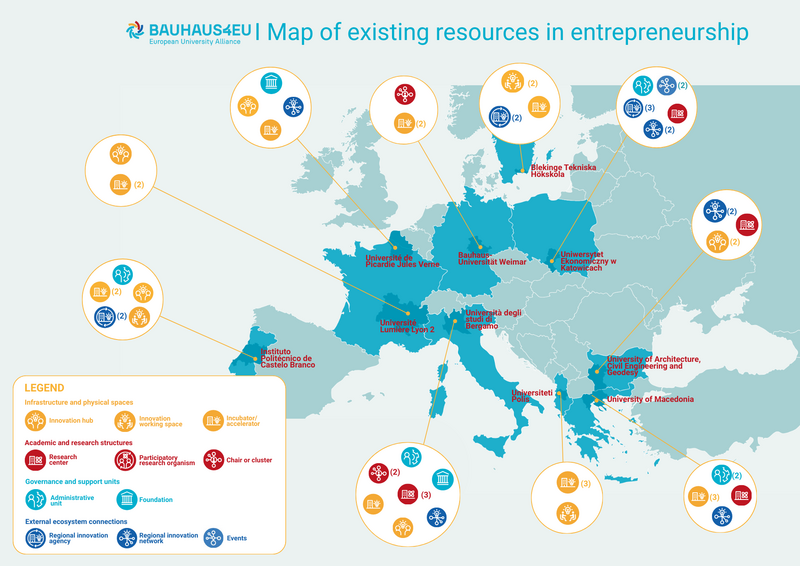
Innovation hub: A physical or digital ecosystem that connects diverse actors, including academia, industry, government, and civil society, to facilitate knowledge transfer, collaborative problem-solving, and the co-creation of innovative (Capdevila, 2019).
Innovation working space: Physical collaborative environment providing facilities, equipment, and networking opportunities for innovation activities.
Incubator/accelerator: Structured program offering mentoring, funding, and support services to foster innovation and develop startups and entrepreneurial ventures.
Research centre: Specialized unit conducting advanced research in specific thematic areas, often with external funding and partnerships.
Chair or cluster: Endowed academic position or research group focused on a particular field, funded by industry, foundations, or government.
Participatory research entity: Collaborative research entity engaging multiple stakeholders (academia, industry, civil society) in co-creation and action research.
Administrative unit (internal): Internal university office managing innovation policies, intellectual property, technology transfer, or expertise.
Foundation: Independent or university-affiliated organisation providing funding, governance, or strategic support for innovation activities.
Regional innovation agency: External organization (company, public institution, NGO) collaborating with the university on innovation projects and regional development.
Regional innovation network: Formal or informal consortium connecting actors (universities, businesses, government, civil society) to strengthen the regional innovation ecosystem.
Events: Organised activities such as workshops, hackathons, conferences, pitch events, or networking sessions that bring together students, researchers, external stakeholders, and regional partners to foster entrepreneurship, innovation, and knowledge exchange.
Key Best Practices within BAUHAUS4EU
Building on the MS11 report's analysis, the BAUHAUS4EU mapping highlights a shared understanding that what truly defines an entrepreneurial university is not its infrastructure, but its culture — one that encourages students to create, collaborate, and take risks. The alliance’s experiences reveal several key best practices that transform analysis into actionable strategies:
Partner universities share a commitment to learning by doing. IPCB’s participation in Poliempreende and Link Me Up – 1000 Ideas demonstrates how real-world co-creation projects strengthen regional innovation while offering students practical entrepreneurial experience. Similarly, ULL2’s evidence-based “get out of the building” approach ensures that entrepreneurial learning is grounded in real market testing and feedback. UEKAT, on the other hand, has introduced consultancy projects to every academic program, thus strengthening its network of partners and enabling students to gain hands-on experience with real-world cases in real-time environments.
UEKAT’s integration of over 100 entrepreneurship-related courses exemplifies how entrepreneurship can be embedded horizontally across academic programs. Likewise, UNIBG’s evolution of HC.LAB into CREO illustrates how successful pedagogical experiments can be institutionalized, ensuring long-term continuity and scaling impact.
Trust-based collaboration with industry, mentors, and alumni networks consistently appears as the scaffolding for sustainable entrepreneurship. BUW’s Neudeli and POLIS’s Tirana Inc. exemplify this, embedding students directly within regional innovation ecosystems and transforming external networks into active learning environments. Likewise, BTH is involved in the project “BEST – Blekinge Entrepreneurship for Smart Growth”, run together with Blekinge Business Incubator (BBI) and funded by Sweden’s Tillväxtverket and Region Blekinge. Its objective is to strengthen entrepreneurial capacity among students, researchers and other actors in Blekinge.
Inclusive programs such as BUW’s Neudeli empowHer show that targeted support for underrepresented groups can significantly broaden participation and foster diversity within the entrepreneurial ecosystem. This aligns with the alliance’s broader mission to democratize access to innovation opportunities.
Dedicated teams — such as ULL2’s RICE representatives, BUW’s Neudeli advisors, or UNIBG’s mentors and IP experts — act as the connective tissue between students, faculty, and external partners. Their presence turns financial and infrastructural resources into effective, human-centered ecosystems of support.

Stay Tuned!
Listen to our BAUHAUS4EU Podcast and sign up for our newsletter – stay up to date on all of our ongoing developments and planned activities!
Download Area
In the Download Area, you can find our communication kit, logos, deliverables and other useful documents.