Urban Youth Ecosystems
Course Title
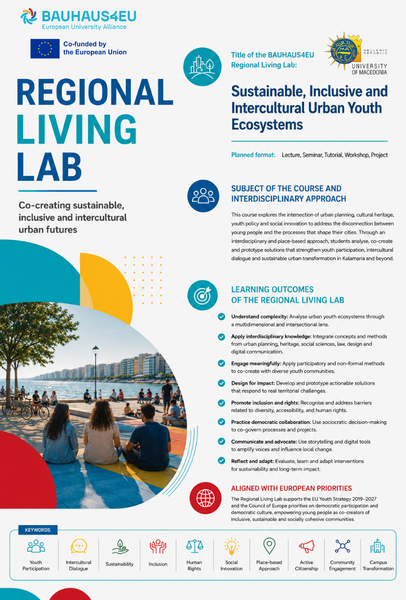
Sustainable, Inclusive and Intercultural Urban Youth Ecosystems
Course Description of Regional Living Lab
The course examines urban youth ecosystems as living, interconnected networks of actors, places, memories, practices, and institutions, addressing the persistent disconnection between young people and the processes through which their cities are planned, governed, and publicly commemorated. Using the municipality of Kalamaria (Thessaloniki metropolitan area) — shaped by 1920s refugee heritage, later waves of migration, and active youth communities — as a shared living laboratory, it tackles a twofold territorial challenge: the deficit of meaningful youth participation in urban co-creation, and the invisibility of living and intangible heritage in spatial planning and civic processes.
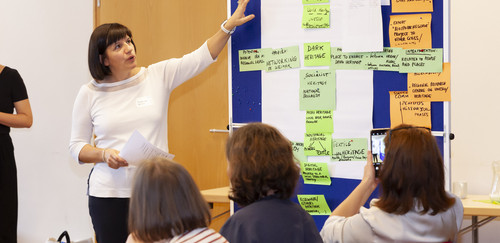
The approach is genuinely interdisciplinary, drawing on urban planning and participatory design, cultural/living and intangible heritage studies, social anthropology, disability studies, human rights law, intercultural studies, social innovation and entrepreneurship, and digital communication / civic technology. Six interconnected modules apply Design Thinking (Empathise–Define–Ideate–Prototype–Test), Non-Formal Education, and sociocratic decision-making through field-based intercultural mapping walks, community interviews, participatory observation, and the co-design of low-cost ‘micro-urban’ interventions that revitalise neglected or underused public spaces.
Partners: Municipal Youth Council of Kalamaria (focal institutional partner); Thessaloniki Youth Club for UNESCO (community outreach and stakeholder engagement); local schools and youth organisations; sports associations; organisations working on disability inclusion, gender equality, and community empowerment; cultural/heritage and community-arts organisations; community spaces; and municipal authorities responsible for spatial planning, public space, and culture/heritage policy.
Expected impact operates across three scales. Student level: a generation of practitioners equipped with participatory, rights-based and inclusive co-creation competencies. Territorial level: tangible outputs (intercultural maps, micro-urban intervention proposals, memory documentation, digital storytelling) feeding community building and planning in Kalamaria and Eastern Thessaloniki, plus a durable university–municipality–civil society collaboration. Alliance/European level: a transferable modular model and documented methodology for replicating Regional Living Labs across the Bauhaus4EU network. The course aligns with the EU Youth Strategy 2019–2027 and the Council of Europe’s youth sector priorities on democratic participation.
Learning Outcomes
"By the end of the course students acquire intellectual, practical, and civic competencies for transformative urban engagement.
Knowledge & understanding: articulate how urban ecosystems function as interconnected (or disconnected) networks of actors, spaces, memories, and institutions; analyse the role of living and invisible heritage in shaping youth identities across intersecting dimensions of gender, disability, migration background, and socio-economic condition; and situate local territorial challenges within broader European debates on urban inclusion, intercultural dialogue, and participatory governance.
Practical & methodological competencies: use intercultural mapping tools to identify social barriers, invisible borders, accessibility challenges, contact zones, and overlooked cultural assets; design and facilitate participatory workshops applying Design Thinking and Non-Formal Education in real-world contexts; and use collaborative digital tools for spatial analysis, community engagement, and amplifying marginalised voices.
Transversal & civic competencies: act as mediators between youth communities, local authorities, cultural organisations, and academic institutions; think critically, exercise intercultural empathy, and synthesise diverse perspectives into viable, locally grounded interventions; and practise inclusive, sociocratic deliberation with a bias for action over paralysis.
Alignment with the New European Bauhaus (NEB) Compass: Sustainability — engaging urban environments as interconnected social, ecological, and spatial systems, with interventions accountable for environmental and social sustainability. Aesthetics / quality of experience — attending to how public spaces are experienced, remembered, and given meaning, beyond purely functional design. Inclusion — central to the course: identifying social barriers and invisible borders, strengthening belonging for marginalised youth, and using participatory methods so all voices shape outcomes. Place-based transformation — operationalised through the Living Lab approach, with students designing in direct engagement with a specific territory, its communities, memories, and challenges. Outcomes also support EU and Council of Europe objectives on youth participation, democratic engagement, social inclusion, and community resilience."
Prerequisites for the Course
None
Registration Info and Deadline
Registration will start around September 2026. UoM participants will be monitored via the student portal of the UoM. non-UoM students will be monitored via a registration portal that will be set up for the purposes of the project
At a Glance
| Where | University of Macedonia |
| Name of lecturer(s) | Kalliopi Chainoglou (Associate Professor, academic coordinator); Lefkothea Kartasidou (Professor); Eleni Sideri (Assistant Professor) |
| Open for students from faculties/degree programmes | Department of International and European Studies; Department of Educational & Social Policy; Department of Music Science & Art; Department of Balkan, Slavic & Oriental Studies; Department of Economics; Department of Applied Informatics; Department of Business Administration; Department of Accounting and Finance |
| Time period | September 2026 – July 2027 (two academic semesters) |
| Year | Open to all students |
| Planned format | Lecture, Seminar, Tutorial, Workshop, Project |
| Required study level(s) | All study levels (open to all students) |
| ECTS | At least 2 ECTS |
| Registration info and deadline | Registration will start arround September 2026. UoM participants will be monitored via the student portal of the UoM. non-UoM students will be monitored via a registration portal that will be set up for the purposes of the project |
| Contact person | Kalliopi Chainoglou – chainoglou@uom.edu.gr |
Stay Tuned!
Listen to our BAUHAUS4EU Podcast and sign up for our newsletter – stay up to date on all of our ongoing developments and planned activities!
Download Area
In the Download Area, you can find our communication kit, logos, deliverables and other useful documents.