Reimagining Brownfields
Course Title
Reimagining Brownfields: Interdisciplinary Living Lab for Sustainable Urban Regeneration
Course Description of Regional Living Lab
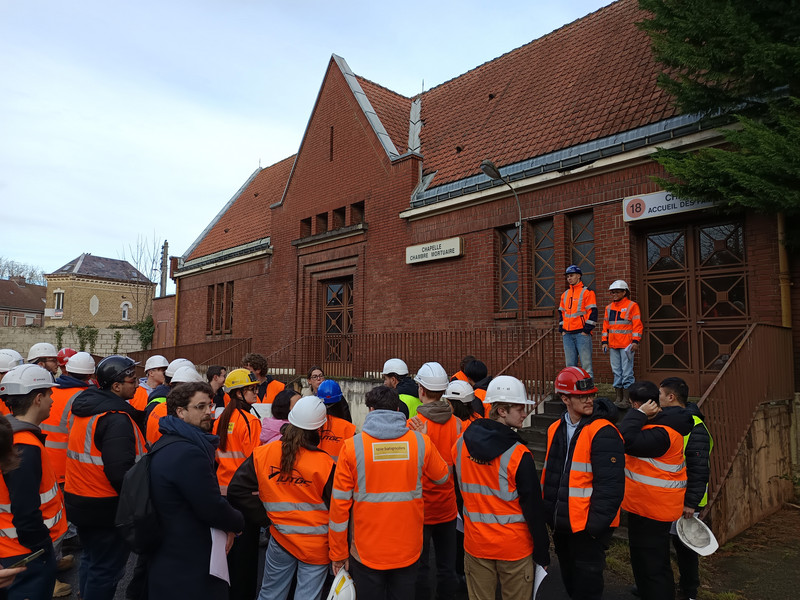
The Somme department currently contains around 500 brownfield sites of various sizes (cartofriches.cerema.fr). At the local level, approximately 50 sites within Amiens are awaiting redevelopment. Although the reasons behind this situation are varied, Amiens Métropole aims to initiate reflection and rehabilitation projects for these spaces. One of these sites is the former Amiens North University Hospital, recently abandoned and located near residential districts and a university campus. In this context, the Territorial Strategy and Urban Planning Department, together with the Project Management Department of Amiens Métropole, propose to support studies dedicated to the redevelopment of these spaces while integrating environmental and social approaches. These include the transformation of the sites for community-oriented uses, the limitation of land artificialisation, and the promotion of circular economy principles.
The Maison de l'Architecture d'Amiens, a cultural association dedicated to architecture, urban planning, and lanscape design, will also contribute to the dissemination and exhibition of the projects, similarly to its current exhibition "On n'a plus de terrain à perdre".
Learning Outcomes
By the end of the course, students will have developed interdisciplinary skills combining social analysis, architectural reflection, environmental awareness, and technical approaches to urban rehabilitation. Through collaborative and project-based learning, students will acquire both theoretical knowledge and practical experience related to the transformation of brownfield sites into inclusive, sustainable, and meaningful spaces for local communities.
Students from Civil Engineering and Sustainable Construction will strengthen their ability to analyse existing buildings and urban spaces, carry out technical and environmental diagnostics, develop rehabilitation strategies, and produce technical, economic, and environmental feasibility studies. Anthropology students will develop competencies related to territorial analysis, participatory approaches, understanding local practices and social needs, and analysing the relationships between populations and urban environments. They will also learn how to conduct territorial diagnoses, analyse socio-spatial dynamics, and translate qualitative observations into recommendations that can inform architectural, urban, and redevelopment projects.
Beyond disciplinary skills, the course aims to develop students’ ability to work collaboratively in interdisciplinary teams and to engage with local stakeholders through participatory processes. Students will learn how to integrate technical, social, environmental, and aesthetic dimensions into a shared redevelopment vision. They will also improve their communication and project management skills through workshops, presentations, exhibitions, and interactions with local authorities and community actors.
The learning outcomes strongly align with the principles of the New European Bauhaus by promoting projects that are beautiful, sustainable, and inclusive. The concept of “beautiful” will be explored through architectural quality, spatial identity, and the creation of meaningful and attractive living environments. “Sustainable” will be addressed through the rehabilitation and reuse of existing buildings, the limitation of land artificialisation, and the integration of environmental considerations into redevelopment strategies. “Together” will be reflected in the participatory and collaborative dimension of the project, involving students from different disciplines as well as local institutions, architects, and territorial stakeholders.
The course also reflects the three fundamental principles of the New European Bauhaus working method: participatory processes, multi-level engagement, and transdisciplinary collaboration. Students will work closely with local authorities, architects, cultural actors, and community stakeholders in order to co-construct redevelopment proposals responding to real territorial challenges.
In addition, the Regional Living Lab approach encourages experimentation and innovation. Students will test new ways of imagining and transforming abandoned urban spaces while remaining connected to existing theoretical frameworks and professional practices. The course is conceived as an evolving and reflective process in which feedback from local stakeholders and the collective experience of participants will continuously contribute to improving the methodology and the proposed solutions.
Finally, by interacting directly with the local territory and its actors, students will gain a deeper understanding of the social, environmental, and cultural dimensions of urban regeneration. The course therefore aims not only to provide technical and academic competencies, but also to foster civic engagement, critical thinking, and long-term responsibility toward sustainable territorial development.
Prerequisites for the Course
Two student profiles are involved in this project.
For third-year Bachelor University of Technology students in Civil Engineering and Sustainable Construction, students are expected to be able to understand building typologies, take into account technical diagnostics related to existing structures, propose technical solutions for building transformation, and develop a technical, economic, and environmental assessment dossier for rehabilitation projects.
For Master’s students in Humanities and Social Sciences, specialising in Anthropology, the project will focus on social analysis, territorial dynamics, and the understanding of local uses and practices related to urban brownfield redevelopment.
Registration Info and Deadline
Enrolment will be done via the enrolment in the Bachelor University of Technology students in Civil Engineering and Sustainable Construction and the Master Anthropology Option Culture and Heritage.
At a Glance
| Where | Université de Picardie Jules Verne |
| Name of lecturer(s) | Lorena Freitas Dutra - lorena.freitas-dutra@u-picardie.fr |
| Open for students from faculties/degree programmes | The project involves students from: The University Institute of Technology (IUT), Department of Civil Engineering and Sustainable Construction and Humanities and Social Sciences (Master Anthropology Option Culture and Heritage) |
| Time period | September 2026 - June 2027 (2026/2027 academic year, two consecutive semesters) |
| Year | Years 3 (Bachelor) and 5 (Master) |
| Planned format | Workshop and Project module |
| Required study level(s) | 3rd year Bachelor and 2nd year Master |
| ECTS | For students enrolled in the Bachelor University of Technology in Civil Engineering and Sustainable Construction (third year), the project is integrated into the Learning and Assessment Situation (Situation d’Apprentissage et d’Évaluation – SAE) 5.01, entitled “Building Project Synthesis” or “Building Rehabilitation Project”, corresponding to 8 ECTS credits. |
| Registration info and deadline | Enrolment will be done via the enrolment in the Bachelor University of Technology students in Civil Engineering and Sustainable Construction and the Master Anthropology Option Culture and Heritage |
| Contact person | Jake Murdoch - jake.murdoch@u-picardie.fr |
Stay Tuned!
Listen to our BAUHAUS4EU Podcast and sign up for our newsletter – stay up to date on all of our ongoing developments and planned activities!
Download Area
In the Download Area, you can find our communication kit, logos, deliverables and other useful documents.