The City, the University, and the Common Good
Course Title
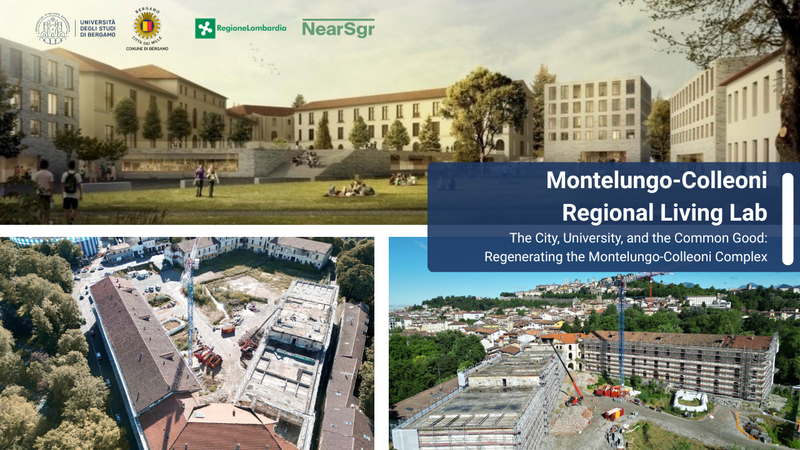
The City, the University, and the Common Good: Regenerating the Montelungo-Colleoni Complex
Course Description of Regional Living Lab
The RLL is anchored in the ongoing regeneration of the Montelungo-Colleoni former barracks in Bergamo, a large abandoned military complex currently being transformed into a new university and urban district integrating educational spaces, student housing, public services, and green infrastructure. Specifically, the development will provide new university teaching and research facilities, as well as 450 student housing units and 80 publicly available apartments, helping to address housing demand in a growing university city. The ongoing regeneration of the Montelungo-Colleoni serves as a real-life territorial challenge and interdisciplinary learning environment inspired by the values and working principles of the New European Bauhaus (NEB). The RLL will be implemented with the support of partners involved in the regeneration project, including the Municipality of Bergamo, the Region of Lombardy, and Near sgr, the real estate asset manager and project developer, as well as Cassa Depositi e Prestiti, Fondazione Cariplo, and Intesa Sanpaolo.
The RLL is structured as two integrated interdisciplinary courses implemented across two semesters. The intended impact of the first semester is to communicate the historical and territorial context of the Montelungo-Colleoni complex and the vision for its future, making the project understandable, relevant, and engaging for the community. The first semester will feature the following three thematic areas: 1) The University of Bergamo and its Historical and Spatial Evolution for Community-Based Urban Regeneration; 2) Urban Planning and Architectural Perspectives for Sustainable and Adaptive Urban Strategies; 3) Archaeology, History, and Collective Memory of the Montelungo-Colleoni site.
The intended impact of the second semester is to generate analyses and proposals that support decisions on the future use of the Montelungo-Colleoni complex, helping to define both its university functions and its broader public role within the city. The second semester will feature the following three thematic areas: 1) photovoice as a creative and collaborative methodology to explore urban regeneration; 2) entrepreneurship and innovation as strategies for territorial development; 3) commercial and public-use functions in the Montelungo-Colleoni complex.
In each semester, students will engage with all presented thematic areas through shared learning activities and collaborative work. Students may participate in one or both semesters of the RLL.
Learning Outcomes
The central learning objective of the Montelungo-Colleoni RLL is to enable students to critically analyze urban regeneration as a social, cultural, economic, and educational process shaped by multiple actors, territorial dynamics, and disciplinary perspectives inspired by the New European Bauhaus principles.
Because the Montelungo-Colleoni development project is ongoing, students will engage and contribute to a live and evolving territorial process through project-based, place-based, and challenge-based learning activities.
By participating in the RLL, students will be able to:
- analyze urban regeneration processes through interdisciplinary perspectives integrating social, spatial, cultural, environmental, and economic dimensions;
- evaluate the relationship between heritage preservation, adaptive reuse, sustainability, and contemporary urban needs;
- identify and critically reflect on the roles of local and regional government, private actors, universities, and communities in territorial transformation processes;
- apply participatory and collaborative approaches to the analysis and interpretation of territorial challenges;
- communicate territorial challenges, project ideas, and analytical findings to both academic and non-academic audiences;
- collaborate effectively in interdisciplinary teams, including using collaborative problem-solving approaches;
- critically reflect on the New European Bauhaus values of sustainability, inclusion, and beauty within the urban regeneration process.
Prerequisites for the Course
None
Registration Info and Deadline
Students who are interested in enrolling in the Regional Living Lab are invited to complete an application form that will be made available on the dedicated UniBg web page, found here: https://en.unibg.it/international/going-abroad/erasmus/bauhaus4eu/b4eu-joint-calls/regional-living-lab.
This application, corresponding application regulations, and the deadlines for the fall and spring semesters will be available in September 2026.
At a Glance
| Where | University of Bergamo |
| Name of lecturer(s) | Department of Foreign Languages, Literatures, and Cultures: Prof. Stefano Morosini; Prof.ssa Federica Burini; Prof.ssa Alessandra Ghisalberti; Prof. Marco Tononi Department of Management: Prof.ssa Daniela Andreini Department of Engineering and Applied Sciences: Prof. Fulvio Adobati; Prof. Vittorio Paris, Prof. Emanuele Garda, Prof. Stefan Vieths, Prof. Davide Prati Department of Letters, Philosophy, and Communication: Prof. Renato Ferlinghetti, Prof.ssa Cecilia Nobili, Prof. Paolo Buffo, Prof. Stefano Brenna, Prof.ssa Anna Chiara Cimoli, Prof. Marco Lanzini, Prof. Jacopo Perazzoli, Prof. Federico Zoni Department of Management, Information, and Production Engineering: Prof. Tommaso Minola Department of Human and Social Sciences: Prof.ssa Cristiana Ottaviano, Prof.ssa Silvia Capretti |
| Open for students from faculties/degree programmes | Open to students from all faculties |
| Time period | October 2026-May 2027 (2026/2027 academic year, two consecutive semesters) |
| Planned format | Lecture, seminar, workshop, field visits, project work |
| Required study level(s) | Open to students from PhD and master's programmes, as well as bachelor's students who have earned at least 60 ECTS by the start of the 2026/2027 academic year |
| ECTS | 6 ECTS each semester |
| Registration info and deadline | Students who are interested in enrolling in the Regional Living Lab are invited to complete an application form that will be made available on the dedicated UniBg web page, linked here: https://en.unibg.it/international/going-abroad/erasmus/bauhaus4eu/b4eu-joint-calls/regional-living-lab. This application, corresponding application regulations, and the deadlines for the fall and spring semesters will be available in September 2026. |
| Contact person | Prof. Stefano Morosini (Regional Living Lab Coordinating Teacher) Questions about the Regional Living Lab may also be directed to the BAUHAUS4EU team at UniBg by emailing: bauhaus4eu[at]unibg.it |
Stay Tuned!
Listen to our BAUHAUS4EU Podcast and sign up for our newsletter – stay up to date on all of our ongoing developments and planned activities!
Download Area
In the Download Area, you can find our communication kit, logos, deliverables and other useful documents.