Mobile Third Place
Course Title
Mobile Third place
Course Description of Regional Living Lab
This course addresses the upcoming renovation of the Sendehalle Weimar, planned for 2027. Since the building will be temporarily unavailable, the challenge is to keep the Sendehalle's cultural, educational, and historical programmes alive and accessible. You will collaboratively design and build a Mobile Culture Cabin - a flexible, adaptable unit that brings exhibitions, artistic projects, and educational formats into public spaces across Weimar, during and beyond the renovation.
A central focus is the use of innovative materials for the renovation, including for example straw bricks - a low-carbon, bio-based building material currently in development at our Architecture Department.
The cabin becomes a real-world testing ground for this new construction method, inviting you to explore its structural, ecological, and aesthetic potential through hands-on design-build processes. The project is developed in close collaboration with local partners. Using participatory design methods, you will work with residents, schools, cultural institutions, and community groups to identify needs, develop concepts, and test ideas. The process is as important as the outcome.
The course is strongly interdisciplinary. Depending on your background, you will contribute different expertise: architecture, and civil and environmental engineering students focus on spatial concepts and sustainable construction; urbanisme students examine suitable locations and urban integration; fine arts and visual communication students shape artistic interventions and develop a visual concept; product design students develop the physical components of the cabin; and media culture and media art students contribute digital storytelling and hybrid communication formats.
The course is guided by the values of the New European Bauhaus - combining sustainability, aesthetic quality, and social inclusion - and creates a living laboratory at the intersection of culture, design, heritage, education, and public space through a mobile third place.
Learning Outcomes
By the end of the course, you will have developed the ability to design, implement, and evaluate participatory cultural interventions that respond to real societal needs while integrating principles of sustainability, aesthetics, and inclusion. Working on the development of a Mobile Culture Cabin for the Sendehalle Weimar, you will gain practical experience in interdisciplinary collaboration, community engagement, and experimental design-build processes. A central learning outcome is the ability to work across disciplinary boundaries. Students from architecture, urbanism, civil engineering, fine arts, product design, and media culture/media art will learn how to integrate different forms of knowledge, methodologies, and creative practices into a shared project.
You will develop competencies in communication, teamwork, and collaborative decision-making, enabling to address complex challenges that cannot be solved from a single disciplinary perspective. Through collaboration with local partners—including a product design company, a high school class, and a group of local residents who regularly meet at the Sendehalle— you will acquire practical skills in participatory design and co-creation.
You will learn how to facilitate dialogue between diverse partners, identify community needs, translate different perspectives into design concepts, and adapt project outcomes through iterative feedback processes. This experience will strengthen your capacity to engage responsibly with communities and to understand users as active contributors rather than passive recipients of design solutions.
You will also gain competencies in sustainable and circular design practices. Through the development of the Mobile Culture Cabin, you will engage with innovative bio-based construction methods, particularly the use of straw bricks currently being researched by the Architecture Department.
You will learn how material choices, construction techniques, and lifecycle considerations influence the environmental impact of built environments and cultural infrastructures. By participating in hands-on prototyping and implementation, you will deepen their understanding of sustainable construction as both a technical and cultural practice. The Mobile Culture Cabin will provide opportunities to develop skills in product design, spatial communication, storytelling, and user-centered design.
You will learn how cultural content can be translated into mobile, adaptable, and accessible formats that activate public spaces and reach audiences beyond traditional institutional settings. Furthermore, you will develop critical awareness of the role of cultural heritage, public space, and creative practice in shaping social cohesion and civic engagement. Through direct interaction with local communities and educational institutions, you will gain insight into how cultural initiatives can foster dialogue between generations, strengthen local identity, and contribute to more inclusive urban environments.
As a result, participants will leave the course with practical experience in co-creative project development, sustainable design and construction, community engagement, and interdisciplinary teamwork. Participants will acquire the competencies needed to contribute to future cultural, spatial, and environmental transformations in line with the ambitions of the New European Bauhaus.
Prerequisites for the Course
None specified
Registration Info and Deadline
Online-info-meeting: September 28
Application: motivation letter in the mail, motivation video and, if available, portfolio
Application deadline: October 6 (WiSe) and April 6 (SoSe)
Send the application per mail: helene.dal.farra@uni-weimar.de
At a Glance
| Where | Bauhaus-Universität Weimar |
| Name of lecturer(s) | Selivanonva Aleksandra, al.selivanova@gmail.com, Media Faculty, Walldorf Marcel, marcel.walldorf@uni-weimar.de, Art and Design Faculty, Fritzler Nelli, nelli.fritzler@uni-weimar.de, Urbanism Faculty, Flohr Alexander, alexander.flohr@uni-weimar.de, Civil and Environment Engineering Faculty, Dal Farra Hélène, helene.dal.farra@uni-weimar.de, Language Center |
| Open for students from faculties/degree programmes | open to all |
| Time period | Start of the course WiSe 26/27: Oct. 19 (during this week) End of the course WiSe 26/27: Feb.1 (during this week) Start of the course SoSe 27: April 19 (during this week) End of the course WiSe 27: Summaery (July 11) |
| Year | |
| Planned format | Workshop, Project |
| Required study level(s) | open to all |
| ECTS | 6 ECTS each semester |
| Registration info and deadline | Online-info-meeting: September 28 Application: motivation letter in the mail, motivation video and, if available, portfolio Application deadline: October 6 (WiSe) and April 6 (SoSe) Send the application per mail: helene.dal.farra@uni-weimar.de |
| Contact person | Hélène Dal Farra, helene.dal.farra@uni-weimar.de |
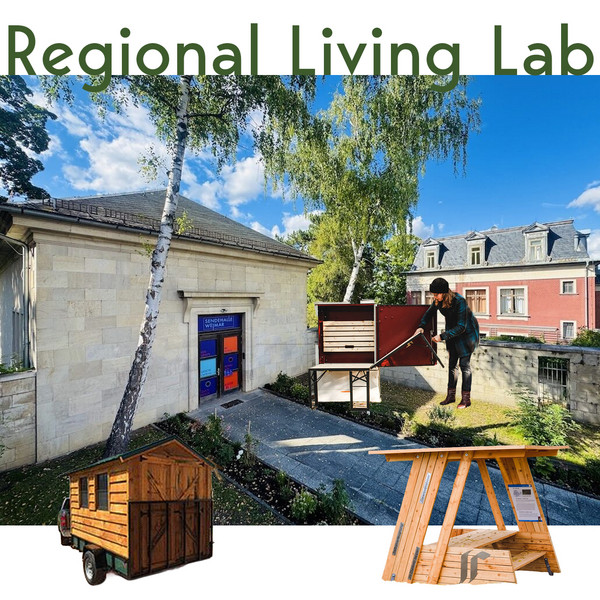
©Stiftung Sendehalle Weimar, ©Rugwind
Stay Tuned!
Listen to our BAUHAUS4EU Podcast and sign up for our newsletter – stay up to date on all of our ongoing developments and planned activities!
Download Area
In the Download Area, you can find our communication kit, logos, deliverables and other useful documents.