Revitalising the Monsanto Community Oven
Course Title
Local cultural heritage: revitalising the Monsanto Community Oven as a Place‑Based Living Lab
Course Description of Regional Living Lab
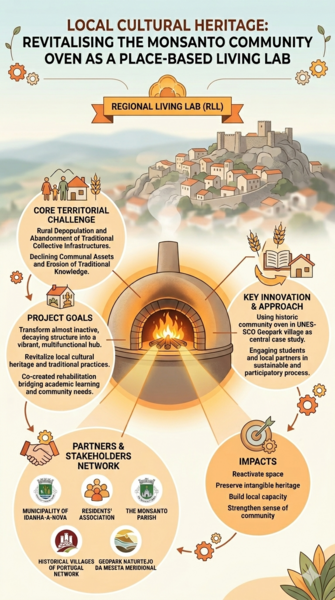
This interdisciplinary Regional Living Lab (RLL) addresses the pressing challenge of rural depopulation and the abandonment of traditional collective infrastructures. Using the historic community oven in the UNESCO Geopark village of Monsanto, Portugal, as its central case study, the project transforms an almost inactive, decaying structure into a vibrant, multifunctional hub. The course aims to revitalize local cultural heritage and traditional practices through a tangible, co-created rehabilitation project that bridges the gap between academic learning and community needs.
The core territorial challenge lies in the decline of communal assets and the erosion of traditional knowledge. The Monsanto community oven, once an important social and economic structure, has been almost unused for over 15 years. This project seeks to reverse this trend by engaging students and local partners in a sustainable and participatory process to reactivate the space. The RLL is designed as a two-semester journey, beginning with a diagnostic and design phase (Semester 1) and culminating in physical interventions and community testing (Semester 2).
A robust network of local and regional partners is essential to the project's success. These include:
- Municipality of Idanha‑a‑Nova that will facilitate administrative permits and connect the project with village elders and key stakeholders.
- Associação de Moradores de Monsanto (Residents' Association) and the Monsanto Parish that wil act as co-hosts for workshops, providers of invaluable oral histories, and future co-managers of the oven after rehabilitation.
- Rede de Aldeias Históricas de Portugal (Historical Villages of Portugal Network), because Monsanto is a member village, and this partner will provide historical context, access to broader networks, and will help disseminate the project's results through their communication channels.
- Geopark Naturtejo da Meseta Meridional, as a UNESCO-certified Geopark, this partner will offer a wealth of historical and geological context and provides another vital platform for disseminating sustainable development results.
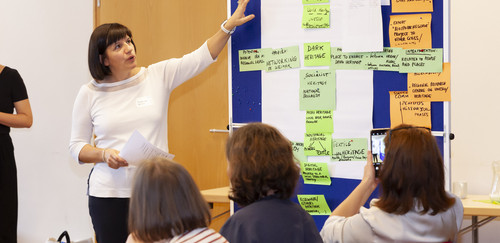
The multidisciplinary teaching team, comprising experts from tourism, cultural studies, hospitality, civil engineering, and interior design, will guide students through an immersive, place-based educational experience. Through field immersion, hands-on workshops, and participatory design sessions, students from diverse backgrounds (Social Sciences, Architecture, Engineering, Design) will collaborate in mixed teams of 4-5 to tackle a shared challenge. They will apply complementary methodologies, from technical structural assessments and ethnographic fieldwork to life-cycle thinking, to develop a low-impact, culturally sensitive rehabilitation plan.
The expected impact of this RLL is multi-faceted. It aims for the physical reactivation of a community asset, targeting use by at least 50 residents per year. It will significantly increase student competence in handling complex, real-world interdisciplinary projects. Furthermore, the project will develop a replication guide that can be adapted for rehabilitating other communal ovens and buildings in the region, offering a scalable model for territorial regeneration. This initiative directly aligns with the New European Bauhaus values by fostering inclusion, promoting sustainability, and enhancing the beauty of the local landscape.
Learning Outcomes
By the end of this immersive, two-semester course, students will have acquired a unique blend of technical, social, and methodological competencies. They will be able to:
- assess an underutilized built space using a combination of participatory action research and technical methods, bridging the gap between community needs and engineering feasibility
- propose an integrated rehabilitation design that respects local heritage, fosters social inclusion, and is co-created with the community
- integrate circular economy and sustainability principles in their design, specifically focusing on the reuse of local materials (stone, lime) and the implementation of bioclimatic solutions (rainwater harvesting, solar lighting)
- co-facilitate a community workshop and public presentation, effectively communicating complex ideas to diverse audiences, including local residents, municipal officials, and academic peers
- reflect critically on the role of universities in territorial regeneration, understanding the ethical and practical dimensions of community-engaged scholarship
This RLL is designed as a tangible embodiment of the NEB values and dimensions.
- Inclusion (Dimension 3: Democracy, Dialogue & Co-creation):
Students will not work for the community but with it. By co-facilitating workshops, collecting oral histories and incorporating resident feedback into iterative designs, students learn to prioritize dialogue and democratic participation in the regeneration process. They will directly engage with the residents' association and municipality, breaking down traditional barriers between the university and the public.
- Sustainability (Dimension 1: Regenerating built heritage):
The project's core technical focus is on low-impact construction techniques and circular economy principles. Students will learn to specify and implement solutions like lime mortar repairs, stone reuse, and local biomass energy, moving beyond theory to practical application. This ensures the project contributes to environmental and economic sustainability on a local scale.
- Beautiful (Dimension 2: Human-scale, sensory experience):
The learning outcomes go beyond mere functionality. By engaging with interior design and wayfinding, students will focus on creating a sensory experience that respects the human scale and historic character of the oven. The final public showcase, an exhibition and open-air festival, will emphasize the "beautiful" dimension by allowing students to curate a presentation that celebrates the cultural landscape and its revitalized heart. This experience teaches them that successful regeneration must also be aesthetically and emotionally resonant.
Ultimately, this course prepares students to become proactive, transdisciplinary professionals capable of tackling the complex social and environmental challenges of the 21st century. They will leave with a portfolio of practical work, a deep understanding of participatory processes and a strengthened commitment to the NEB values.
Prerequisites for the Course
Basic knowledge of teamwork and willingness to work in a rural, community‑based setting. Technical background required (in the areas previously mentioned) and interdisciplinary groups will be formed
Registration Info and Deadline
- Autumn Semester (2026/2027): October 22, 2026
- Spring Semester (2026/2027): February 19, 2027
Registration here.
Online/ In sito Information Sessions
- For the Autumn Semester: October 23, 2026
- For the Spring Semester: February 25, 2027
At a Glance
| Where | Polytechnic University of Castelo Branco |
| Name of lecturer(s) | School of Business, Tourism and Law - Professor George Ramos; Professor André Costa; Professor Ricardo Martins School of Technology - Professor Ana Vaz Ferreira School of Arts - Liliana Neves |
| Open for students from faculties/degree programmes | Bachelor students Master students Social Sciences and Humanities, Architecture and Engineering, Agriculture and Environmental Sciences, Design and Arts. Students from other faculties are welcome upon justification |
| Time period | September 2026 – July 2027 |
| Year | |
| Planned format | Seminar Workshop Project |
| Required study level(s) | Bachelor students Master students |
| ECTS | 6 ECTS total |
| Registration info and deadline | Registration here.
|
| Contact person | Professor Sandra Teixeira - sandra.teixeira@ipcb.pt; Joana Dias - b4eu@ipcb.pt |
Stay Tuned!
Listen to our BAUHAUS4EU Podcast and sign up for our newsletter – stay up to date on all of our ongoing developments and planned activities!
Download Area
In the Download Area, you can find our communication kit, logos, deliverables and other useful documents.