FЮЖЕN*
Course Title
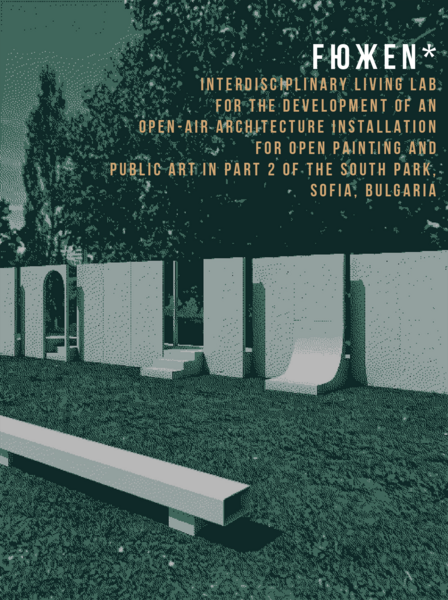
FЮЖЕN* – Interdisciplinary Living Lab for the development of an open-air architecture installation for open painting and public art in part 2 of the South Park, Sofia, Bulgaria
Course Description of Regional Living Lab
FЮЖЕN: Living Lab for Public Art, Architecture and Urban Transformation is an interdisciplinary design-build course that explores how architecture can act as a mediator between public space, artistic expression, community life, and urban ecology. The course is centered on the transformation of an open green public area in South Park 2, adjacent to Toplocentrala – Regional Centre for Contemporary Arts in Sofia. Rather than introducing intensive construction into the park, the project seeks to create a new cultural and aesthetic layer through the design and realization of an open and accessible architectural structure dedicated to urban painting, artistic installations, and interdisciplinary creative practices.
The course addresses several contemporary territorial challenges. Although Sofia possesses a number of legal spaces for urban art, these are predominantly located in peripheral areas that are often perceived as less accessible, less visible, and less welcoming to a diverse range of users. The project responds by proposing a new model in which artistic practices are integrated into a central, active, and shared public environment. The intervention aims to demonstrate how public space can accommodate artistic production, cultural participation, and everyday urban life simultaneously, creating a safer, more inclusive, and culturally vibrant setting.
The educational process is organized as a Real-Life Learning Lab combining research, design, prototyping, participation, and implementation. Students from the Departments of Public Buildings, Urban Planning, and Drawing and Modelling at UACEG collaborate throughout the project, bringing together different approaches to spatial analysis, design, representation, and placemaking. The course is further enriched through collaboration with students and representatives of the National Academy of Art, creating opportunities for exchange between architectural and artistic disciplines.
The project is developed in partnership with a broad network of cultural, educational, and civic organizations. Key partners include the Visionary Foundation, which brings expertise in public art, mural culture, and community engagement, as well as Toplocentrala – Regional Centre for Contemporary Arts, which provides an important cultural context for the intervention. Additional contributions are expected from local cultural foundations, artists, architects, urban practitioners, and international academic partners who will participate through lectures, workshops, mentoring, and project reviews.
A central ambition of the Living Lab is to create not only a successful architectural intervention but also a long-term framework for future development. The structure is conceived as a living platform rather than a finished object. Students are encouraged to embed within their proposals the capacity for future growth, modification, and reinterpretation. New artistic layers, additions, community-led initiatives, and future student interventions are anticipated as part of the project’s evolution. In this sense, adaptation and transformation are understood as forms of sustainability, allowing the project to remain socially and culturally relevant over time.
The expected impact of the course is educational, cultural, social, and spatial. Students will acquire practical experience in interdisciplinary collaboration, participatory design, public engagement, and implementation processes while developing a deeper understanding of architecture as a cultural and civic practice. The project will strengthen collaboration between architecture, urban planning, visual arts, and cultural organizations, while contributing a new platform for public art and creative expression within Sofia’s urban landscape.
Beyond the immediate outcomes of the course, the Living Lab seeks to establish a durable network of partnerships and a replicable educational model capable of supporting future student cohorts and new collaborative projects. By connecting architecture, art, community participation, and environmental awareness, the project contributes to the New European Bauhaus vision of creating sustainable, inclusive, and beautiful public environments that continue to evolve long after their initial realization.
Learning Outcomes
By the end of the course, students will have developed the ability to conceive, design, communicate, and potentially realize small-scale public architectural interventions that operate as social, cultural, and ecological catalysts within the urban environment. Through research, design development, interdisciplinary collaboration, and participation in the realization process, students will gain competencies that extend beyond conventional building design and position architecture as a mediator between people, place, creativity, and public life.
Students will acquire the ability to critically analyze complex urban contexts by investigating the historical, spatial, environmental, social, and cultural layers that shape a site. They will learn to identify relationships between users, activities, movement patterns, and local narratives, and to translate these observations into informed design strategies. The course will strengthen their capacity for site-specific thinking, evidence-based decision-making, and the interpretation of public space as a dynamic and evolving environment.
A central learning outcome is the development of placemaking competencies. Students will understand how architecture can create conditions for encounter, participation, and collective experience rather than functioning solely as an autonomous object. They will learn to design spaces that support community building, intergenerational exchange, creative expression, and public engagement while responding to the everyday realities of urban life.
The course will foster the ability to work across disciplinary boundaries, integrating architecture, urban planning, visual arts, public art practices, cultural programming, and community-oriented initiatives. Through collaboration with students from different disciplines, artists, cultural organizations, and external experts, participants will gain experience in teamwork, communication, negotiation, and collaborative decision-making. They will develop an understanding of how architectural frameworks can support artistic production, exhibition, interaction, and cultural participation.
Students will develop skills in generating innovative spatial and morphological concepts that respond creatively to social, environmental, and cultural challenges. Particular emphasis is placed on architecture as temporal, adaptive, and evolving, encouraging students to explore flexible interventions capable of growth, transformation, and reinterpretation over time rather than static and permanent solutions.
The course will strengthen students’ understanding of sustainable and responsible design. Participants will learn to evaluate materials, construction systems, maintenance requirements, and lifecycle considerations while engaging with principles of circularity, resource efficiency, adaptability, and stewardship of public space. Through the design of reusable and transformable structures, students will explore sustainability not only as environmental performance but also as the capacity of places to remain socially and culturally relevant over time.
An important component of the course is the connection between design and implementation. Through prototyping, testing, and the potential realization phase, students will gain first-hand experience of fabrication, construction, coordination, and project delivery. This experience will strengthen their understanding of the relationship between conceptual intent and built reality while providing practical skills that support their future professional development.
Students will also improve their ability to communicate architectural ideas through drawings, models, visual narratives, presentations, and experimental representational techniques. They will learn to articulate design intentions, justify decisions, engage in critical discussion, and communicate effectively with professional partners, public institutions, artists, and community stakeholders.
For Master's students in Public Buildings and Urban Planning, the course provides a valuable bridge between academic education and future professional practice. By addressing architectural, urban, artistic, social, and environmental questions simultaneously, students develop the ability to formulate complex design responses that extend beyond the scale of a single building. The course strengthens their capacity to act as designers, facilitators, and active contributors to cultural and spatial transformation within contemporary cities. Alignment with the New European Bauhaus Compass
The learning outcomes align closely with the three core values of the New European Bauhaus: Sustainability, Inclusion, and Aesthetics. Sustainability is addressed through the exploration of adaptable, reusable, and evolving architectural structures designed to support long-term stewardship of public space. Students are encouraged to consider lifecycle thinking, circular construction principles, maintenance, and the capacity of architecture to remain relevant through transformation and growth. Inclusion is embedded through participatory design processes, interdisciplinary collaboration, community engagement, and the creation of accessible public environments that support diverse users and encourage active cultural participation. Aesthetics is explored through the integration of architecture and public art, emphasizing creativity, sensory experience, cultural expression, and the ability of design to generate meaningful places that enrich everyday life.
The course further reflects the New European Bauhaus principles of participation, transdisciplinarity, and multi-level engagement by bringing together students, artists, cultural organizations, educators, public institutions, and local communities in a shared process of learning, design, and making. In doing so, it prepares future architects and urban practitioners to contribute to resilient, inclusive, and culturally vibrant public environments capable of evolving long after their initial realization.
Prerequisites for the Course
No prior experience in public art, placemaking, or design-build projects is required. The course is designed to introduce students to these fields through interdisciplinary collaboration and engagement with external experts and stakeholders.
Registration Info and Deadline
Registration starts: 1st week of winter semester of school year 2026/2027, Registration deadline: the end of 2nd week of winter semester
At a Glance
| Where | University of Architecture, Civil Engineering and Geodesy |
| Name of lecturer(s) | Faculty of Architecture - Department of Public Buildings - Chief Assist. Prof. Antonina Ilieva (Arch.), PhD Department of Drawing and Modeling - Assoc. Prof. Orlin Ivanov, PhD Department of Urban Planning - Assist. Prof. Milena Fetvadjieva (Arch.) |
| Open for students from faculties/degree programmes | Faculty of Architecture, particularly within the Departments of Public Buildings and Urban Planning (5th year students in UACEG and Erasmus students of comparable background, equivalent to Master's degree level students in their first year) |
| Time period | September 2026 to July 2027 |
| Year | Year 5 |
| Planned format | Lecture, Seminar, Workshop, Project |
| Required study level(s) | The course is intended for advanced course architecture students enrolled in the Master's programmes of the Faculty of Architecture, particularly within the Departments of Public Buildings and Urban Planning, who have also already completed the obligatory courses in Drawing and Modeling, included in the general curriculum and are continuing towards a more personalized curriculum. Participants are expected to possess foundational knowledge and skills in architectural and urban design, spatial analysis, visual communication, and design representation acquired through previous coursework. Students should be capable of conducting independent research, developing design concepts, and communicating ideas through drawings, models, and presentations. |
| ECTS | 4 ECTS credits (25 to 30 hours each of the two semesters) |
| Registration info and deadline | Registration starts: 1st week of winter semester of school year 2026/2027, Registration deadline: the end of 2nd week of winter semester |
| Contact person | Antonina Ilieva - ailieva_far@uacg.bg |
Stay Tuned!
Listen to our BAUHAUS4EU Podcast and sign up for our newsletter – stay up to date on all of our ongoing developments and planned activities!
Download Area
In the Download Area, you can find our communication kit, logos, deliverables and other useful documents.