CLIL Territories
Course Title
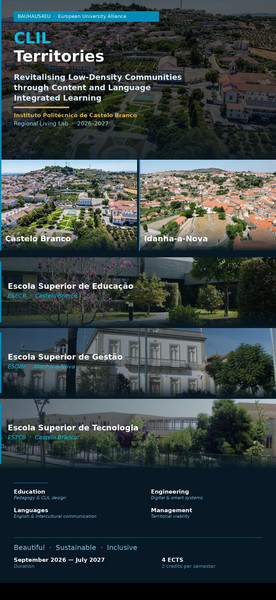
CLIL Territories: Revitalising Low-Density Communities through Content and Language Integrated Learning
Course Description of Regional Living Lab
This course addresses the challenge of regenerating underused and heritage spaces in low-density territories, using Content and Language Integrated Learning (CLIL) as its core methodological framework. Set in the territories of Castelo Branco and Idanha-a-Nova in interior Portugal, the course brings together bachelor's students from three UPCB schools (ESECB, ESGIN, and ESTCB) and four faculty members from the fields of Education, English and Modern Languages, Management, and Electrical Engineering. Working in mixed-discipline teams and entirely in English, students conduct field research, engage with local communities and municipal partners, and co-design regeneration proposals for underused or vacant spaces in the two territories.
The course runs over two consecutive semesters and culminates in a public exhibition where student proposals are presented to community members, local authorities, and regional stakeholders. It aims to demonstrate how interdisciplinary collaboration, multilingual communication, digital innovation, and heritage-sensitive design can together contribute to more sustainable and inclusive futures for interior Portuguese territories.
Learning Outcomes
By the end of the course, students will be able to work effectively in interdisciplinary teams on real territorial challenges, communicating and producing work in English across professional and civic contexts. They will have developed competences in field research, community engagement, and the co-design of territory regeneration proposals that integrate educational, linguistic, managerial, and technical perspectives. The course aligns with the New European Bauhaus values of beauty, sustainability, and inclusion: students engage with the aesthetic and cultural dimensions of heritage spaces, prioritise adaptive reuse over new construction, and ensure that community voices shape their proposals throughout. They will leave the course with a concrete project output, a regeneration proposal developed through authentic collaboration with real communities and with the intercultural and professional competences needed to contribute to European networks of territorial innovation.
Prerequisites for the Course
No formal prerequisites are required. A basic working knowledge of English is recommended, given the CLIL format of the course.
Registration Info and Deadline
- Autumn Semester (2026/2027): October 22, 2026
- Spring Semester (2026/2027): February 19, 2027
Registration here.
Online/ In sito Information Sessions
- For the Autumn Semester: October 23, 2026
- For the Spring Semester: February 25, 2027
At a Glance
| Where | Polytechnic University of Castelo Branco |
| Name of lecturer(s) | School of Education: Professor Sónia Faria and Professor Mónica Régio School of Management, Law and Tourism: Professor Carlos Sampaio School of Technology: Professor Paula Pereira |
| Open for students from faculties/degree programmes | Open for all studens The course is open to bachelor's students from all three UPCB schools involved: School of Education (ESECB), School of Management, Law and Tourism (ESGIN), School of Technology (ESTCB) and the Language Centre of IPCB (CILCE). Students from other UPCB schools are also welcome to apply. |
| Time period | September 2026 - July 2027 |
| Year | |
| Planned format | Seminar Workshop Project |
| Required study level(s) | open to all |
| ECTS | 4 ECTS total |
| Registration info and deadline | Registration here.
|
| Contact person | Professor Mónica Régio - monicaregio@ipcb.pt; Joana Dias - b4eu@ipcb.pt |
Stay Tuned!
Listen to our BAUHAUS4EU Podcast and sign up for our newsletter – stay up to date on all of our ongoing developments and planned activities!
Download Area
In the Download Area, you can find our communication kit, logos, deliverables and other useful documents.