Bioclimatic and Inclusive Cities
Course Title
Bioclimatic and inclusive cities. Planning and urban development perspectives for local authorities.
Course Description of Regional Living Lab
The Regional Living Lab Bioclimatic and Inclusive City addresses two major territorial challenges identified by municipalities near Lyon, the Saône-Beaujolais Community of Municipalities and the City of Villeurbanne, on adapting cities to climate change while ensuring that urban development remains inclusive and accessible to all. Using the territories of Belleville-en-Beaujolais and Villeurbanne as living laboratories, the project explores three interconnected themes: bioclimatic and resilient urban planning, hospitality and housing for all, and the circular use of resources and materials. These themes are examined across different spatial scales, from the territorial and neighbourhood levels to urban projects and individual plots.
The programme combines lectures, field visits, workshops, foresight exercises, and consultancy-based projects. During Semester 1, students acquire the theoretical and methodological foundations needed to analyse contemporary urban challenges. Through case studies, expert contributions, and site visits, they explore topics such as climate adaptation, urban hospitality and emergency housing, circular economy, and material reuse. Particular attention is given to the urban development project “Belleville-en-Beaujolais: a Bioclimatic and Positive City by 2035”, which serves as a common case study throughout the programme.
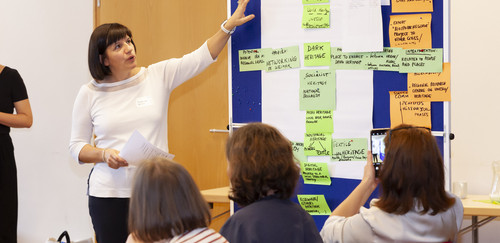
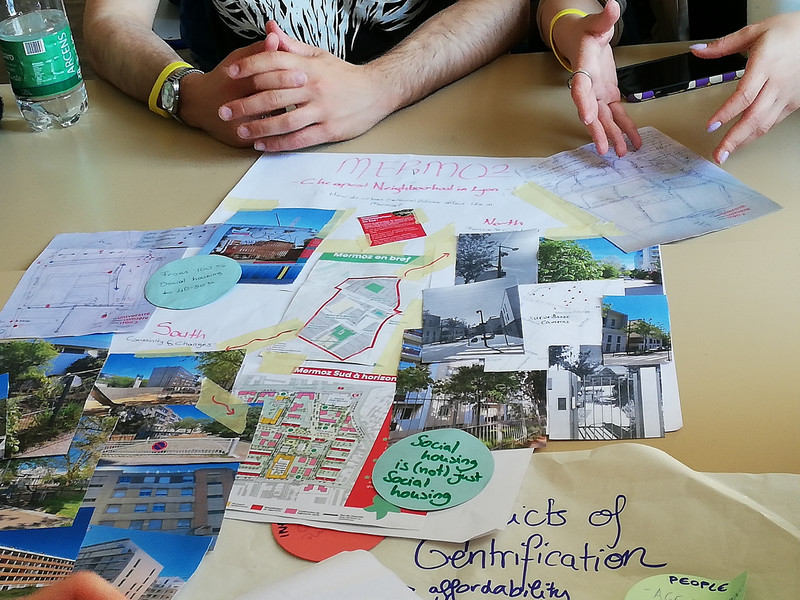
In Semester 2, students apply this knowledge through professional workshops commissioned by local authorities and planning stakeholders. Working in teams, they conduct field investigations, engage with stakeholders, and develop evidence-based recommendations on issues such as the evaluation of bioclimatic urban projects, local hospitality policies, the creation of a territorial materials library, and opportunities for urban recycling within regeneration projects.
For Master 2 students, additional foresight workshops focus on tactical urbanism, climate adaptation, and equitable access to renewable energy. Through benchmarking, scenario building, and exchanges with researchers and practitioners, students explore innovative pathways for sustainable and inclusive territorial transitions. Their findings are then shared with the wider cohort and contribute to collective reflection on future urban development strategies.
Learning Outcomes
The course provides students with a multidisciplinary understanding of contemporary urban challenges and sustainable development practices. It covers bioclimatic urban planning, with a focus on climate adaptation, environmental quality, and resilient design, as well as circular economy approaches to resource circulation at territorial and local scales. It also addresses inclusive urban development, housing policies, hospitality, and emergency accommodation, highlighting the social dimensions of urban transformation. Students gain insight into the diverse disciplines, actors, and governance frameworks involved in urban projects, including planning, geography, environmental studies, landscape, sociology, and public policy.
The course introduces foresight methods to analyse long-term trends and future urban and territorial developments. Students develop skills in data collection, analysis, synthesis, and communication through fieldwork, interviews, surveys, documentary research, and spatial representation. They learn to produce maps, diagrams, reports, and presentations for different audiences. Teamwork and project management are reinforced through collective planning, coordination, and deadline management. Students also practice responding to consultancy-type assignments by engaging stakeholders and proposing context-sensitive solutions.
Aligned with the New European Bauhaus, the course explores urban projects that combine sustainability, inclusion, and quality of life. Through project-based learning, students experiment with the NEB values of being “beautiful, sustainable and together”. The pedagogical approach promotes participatory, multilevel, and transdisciplinary work, and encourages reflection on innovative forms of collective action and long-term urban transformation.
Prerequisites for the Course
Bachelor’s degree or Year 4 (equivalent) in a field related to urban studies (geography, urban planning, sociology, anthropology, history, law, political science, social sciences, or economics), or in urban planning, spatial planning, or urban development.
Registration Info and Deadline
Students in the Master’s program in Urban Planning and Development at Lyon 2 will complete their course registration on the IPWEB platform at the beginning of the semester and will be enrolled before September 7.
At a Glance
| Where | Université Lumière Lyon 2 |
| Name of lecturer(s) | Rachel Linossier - Lyon Institute of Urbanism; Faculty of Geography, History, Art history and Tourism Laetitia Mongeard - Lyon Institute of Urbanism; Faculty of Geography, History, Art history and Tourism Elise Roche - Lyon Institute of Urbanism; Faculty of Geography, History, Art history and Tourism |
| Open for students from faculties/degree programmes | Open for Master’s students in Urban Planning and Development |
| Time period | September 2026 – July 2027 (two academic semesters) |
| Year | Years 4 and 5 |
| Planned format | Lecture Tutorial Workshop Internship |
| Required study level(s) | Bachelor degree or Year 4 |
| ECTS | Year 4: 4 ECTS (S1) 24 ECTS (S2) Year 5: 2 ECTS (S1) 2 ECTS (S2) |
| Registration info and deadline | Students in the Master’s program in Urban Planning and Development at Lyon 2 will complete their course registration on the IPWEB platform at the beginning of the semester and will be enrolled before September 7. |
| Contact person | Rachel Linossier - rachel.linossier@univ-lyon2.fr |
Stay Tuned!
Listen to our BAUHAUS4EU Podcast and sign up for our newsletter – stay up to date on all of our ongoing developments and planned activities!
Download Area
In the Download Area, you can find our communication kit, logos, deliverables and other useful documents.