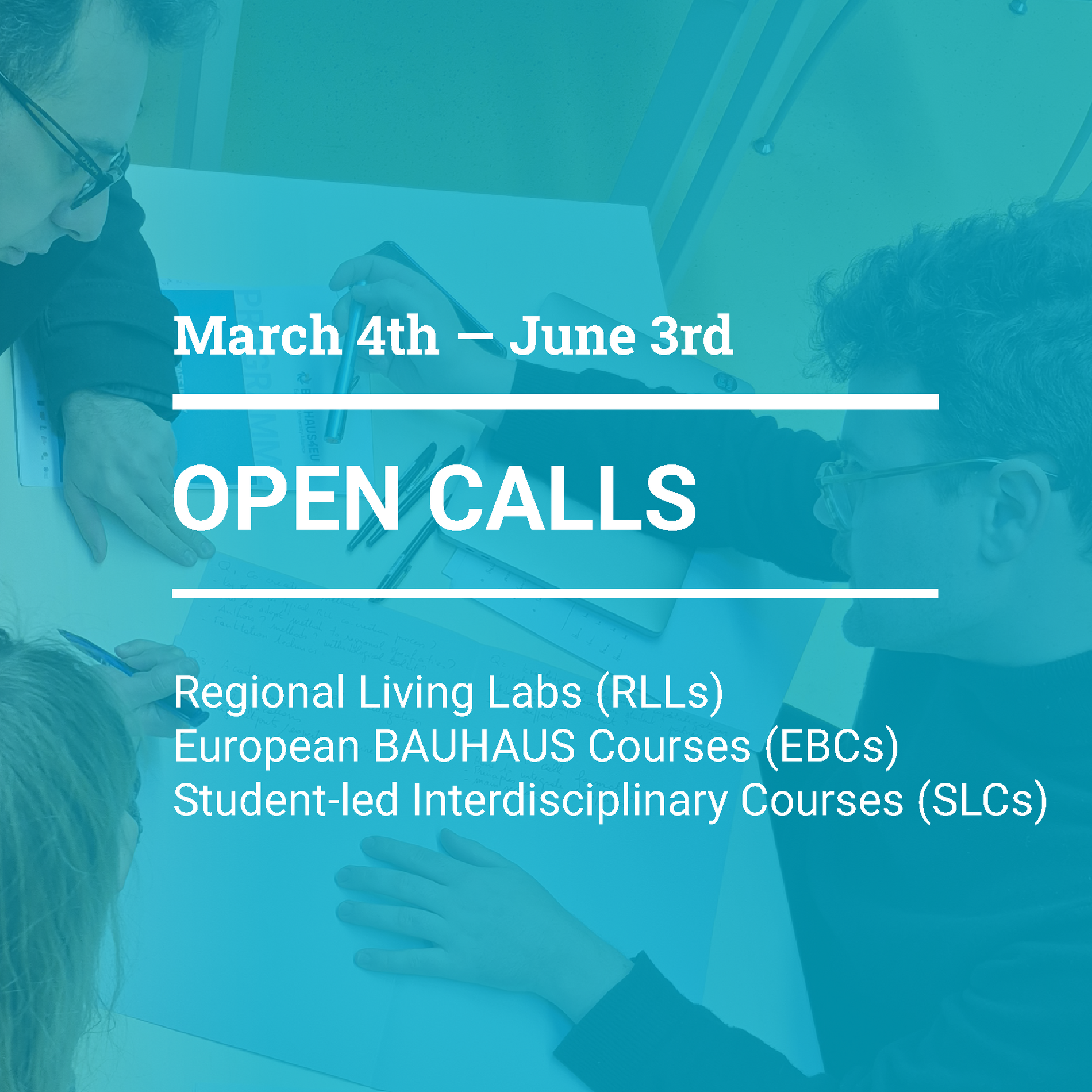
A New, Interdisciplinary Course Format: European BAUHAUS Courses (EBC)
Interested applicants can register for an online information session on 30 March here.
European BAUHAUS Courses (EBC) are innovative, interdisciplinary and challenge-based learning formats inspired by the principles of the New European Bauhaus (NEB) Initiative.
They enable teaching staff to develop joint courses with European partners, increase the international visibility of their discipline, collaborate with external stakeholders, and contribute to transformative learning.
Course proposals must address one of the following thematic areas:
- Climate, Energy, Mobility;
- Culture, Creativity and Inclusive Society; or
- Digital Transformation and AI.
European BAUHAUS Courses can be implemented through different course formats that follow one of three complementary strands that come with specific forms of financial, organisational or technical support provided by the Alliance: Blended Intensive Programme (BIP), Collaborative Online International Learning (COIL) or Hackathon.
The detailed call as well as all information regarding eligibility, submission criteria and contacts can be found https://www.bauhaus4.eu/academics/open-calls-academics/.
Platforming Fresh Ideas and Empowering Students: Student-Led Courses
Students from the BAUHAUS4EU Alliance are invited to design their own Student-Led Courses and help transform their campus into a greener and more inclusive place!
With the support of an academic mentor, students can organise their own course – from educational formats like seminars and lectures series to workshops, project modules and tutorials – and bring their ideas to life.
Students can be Bachelor, Master or PhD level and must align the course content with the United Nations Sustainable Development Goals (SDGs) and the NEB Compass. They will also receive pedagogical training.
All information regarding the Student-Led Courses can be foundhttps://www.bauhaus4.eu/students/open-calls-students/.
Putting experimental learning into practice: Regional Living Labs (RLL)
Interested applicants can register for an online information session on 27 March here.
Regional Living Labs operate as experimental learning environments, encouraging interdisciplinary teaching formats and collaboration across faculties to engage students from diverse academic backgrounds.
Learning activities are embedded in real regional contexts and developed in close interaction with local actors, social environments, and community knowledge.
Ideally, RLLs focus on the revitalisation, reuse, and transformation of unused or vacant built and unbuilt spaces in both urban and rural contexts.
Eligible applicants are teaching staff from partner universities within the BAUHAUS4EU consortium, working with an interdisciplinary approach. Each Regional Living Lab may receive funding of up to €10,000 to support its development and implementation. Teachers will receive pedagogical support on interdisciplinary course development.
The detailed call as well as all information regarding eligibility, teacher support, submission criteria and contacts can be foundhere: https://www.bauhaus4.eu/regional-engagement/open-calls .