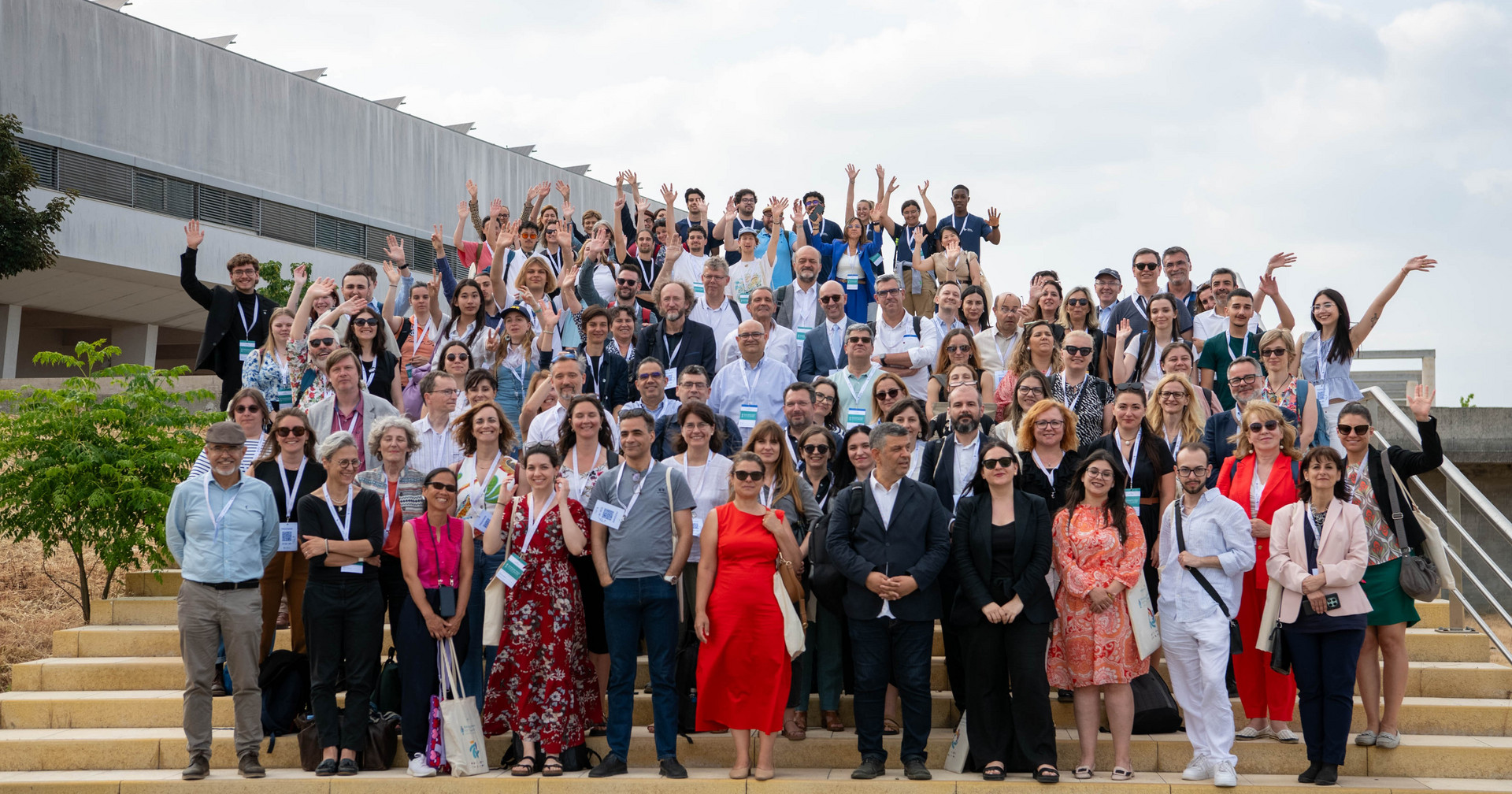
Studying all over Europe!
Explore Europe, your way! Ten universities, endless possibilities — online or in person.
Pick a course and discover how you can make the most of this unique opportunity!
Within our Alliance, you can grow your knowledge, skills, and career flexibly to match your needs.
Curious? Have a look at our course catalogue and FAQs!
Process and Project Management
68 ECTSProcess and Project Management
At a glance
Synchronous Online Teaching
7.5 ECTS
Blekinge Institute of Technology
English language
#Critical thinking #Digital & online methods #Digital & smart technologies
Course Description
The course aims to develop the student's knowledge of industrial business processes as well as tools and methods to manage and control them. The course also aims to develop the student's understanding of and ability to lead and manage projects. A further purpose is to increase the students' understanding of how process and project management can be used to develop and improve businesses.
Content:
- Process and project management have become common tasks in large and small organizations, as well as a dominant work form in many industrial and technology-intensive organizations.
- The course is a summary of process and project management disciplines, with a special focus on management and working methods in business, development, and innovation projects within technology-intensive companies.
- Combined with case studies, the course provides tools and methods for process and project management.
- A large attention is also paid to the role of the project manager in technology-intensive sectors and research and development work.
Learning Outcomes
Knowledge and understanding
On completion of the course, the student will be able to:
- Describe the general structure of the project management theory as both a practical and scientific emerging knowledge field.
- Understand the relationship between projects and their external environment, as well as carry out a stakeholder analysis for a specific project.
Competence and skills
On completion of the course, the student will be able to:
- Formulate project goals that are business-oriented, user-connected, realistic, solution-neutral, and assessable.
- Analysis of practical problems in an industrial business context by means of project management tools and theoretical models.
Judgment and approach
On completion of the course, the student will be able to:
- Describe, choose, and use tools for detailed time planning, workflows, project budgeting, as well as project monitoring in a project's execution.
- Use tools and models from the course to give recommendations on how the control of a project can be prepared, carried out, and improved.
Prerequisites
Completed courses of 30 credits in technology, of which at least 6 credits are in industrial economics and management
How to Apply
Please send us an email by 25/11/25 including the course you would like to participate in, your study program at your home university, your name and date of birth, your phone number, and your transcript of records to: in.exchange[at]bth.se. We will contact you with further details regarding your registration if there are available seats.
Leadership in High-Technology and Knowledge-Intensive Organizations
68 ECTSLeadership in High-Technology and Knowledge-Intensive Organizations
At a glance
Synchronous Online Teaching
7.5 ECTS
Blekinge Institute of Technology
English language
(10 weeks)Responsible: Martin Svensson: martin.svensson[at]bth.se
#Critical thinking #Digital & online methods #Digital & smart technologies #Creativity and Innovation
Course Description
The course aims to develop the student’s understanding of high-tech and knowledge-intensive organizations and their specific conditions for leadership. A further aim is to develop the student’s insight into modern leadership practices, e.g., concerning their main principles and underlying assumptions, as well as the student’s ability to reflect upon her/his own leadership behavior and attitudes. Content: Leadership is the ability to influence a group of people towards a goal. With a focus on leadership in high-tech and knowledge-intensive organizational contexts, the course covers different leadership behaviors and styles, combining classical wisdom, recent research, theory, and practice. The course provides the students with a theoretical understanding of leadership in modern organizations, as well as practical insight into what it means to be a leader. By giving insightful feedback on each other’s actual performance, the course gives students an opportunity to look into one’s personal leadership capabilities.
Learning Outcomes
Knowledge and understanding
On completion of the course, the student will be able to:
- Understand basic aspects of high-tech and knowledge-intensive organizations.
- Describe, discuss, and synthesize relevant models and theories about leadership.
- Apply knowledge about leadership theories and models in practical exercises and case studies.
Competence and skills
On completion of the course, the student will be able to:
- Analyze and evaluate the role and challenges of leadership in high-tech and knowledge-intensive firms.
- Develop their own leadership capacities through feedback, reflection, and practice.
- Evaluate leadership problems and possibilities.
Judgement and approach
On completion of the course, the student will be able to:
- Increase awareness of his/her personal leadership style.
- Strengthen his/her leadership skills, e.g., interpersonal skills, team development, conflict management, communication, and change skills.
Prerequisites
Completed courses of 30 credits in technology, of which at least 6 credits are in industrial economics and management.
How to Apply
Please send us an email by 15/02/26 including the course you would like to participate in, your study program at your home university, your name and date of birth, your phone number, and your transcript of records to: in.exchange[at]bth.se. We will contact you with further details regarding your registration if there are available seats.
Strategy and Business Models in Technology-intensive Businesses
68 ECTSStrategy and Business Models in Technology-intensive Businesses
At a glance
Synchronous Online Teaching
7.5 ECTS
Blekinge Institute of Technology
English language
#Critical thinking #Digital & online methods #Creativity and Innovation #Self-awareness and management
Course Description
The course aims to develop the student’s knowledge of strategy and business models, as well as the connection between them, with a focus on technology-intensive businesses. The course also aims to develop the student’s ability to use appropriate models and tools to analyze and develop strategies and business models within technology-intensive businesses. Content: The course is introduced with an overview of the different schools of strategic management. Starting with the classical strategic management theory and extending to frameworks such as “resource-based view”, “knowledge-based view”, and “attention-based view” on different resources and competences as the key basis for competitiveness. The course moves to the digital era, where practical and ethical issues pose new challenges to the strategic managers of today. The course uses theory and research to explore ways in which the contextual element of business models may be understood and acted upon. To highlight the differences in demands on the leadership in technology-intensive businesses, different leadership styles in big corporations, as well as in small new ventures with quite different types of objectives, are discussed.
Learning Outcomes
Knowledge and understanding
On completion of the course, the student will be able to:
- Grasp key concepts in strategic management research and practice.
- Understand strategic decision-making in knowledge and technology-intensive industries.
- Understand implications of digitalization on strategy, organizational structure, and business models in technology-intensive industries.
Competence and skills
On completion of the course, the student will be able to:
- Use theories, models, and concepts to analyze complex practical issues and suggest appropriate solutions.
- Integrate different models and concepts in a coherent analysis of a strategic situation.
- Present their analysis and conclusion by using the theoretical foundation; articulate their argument clearly and unambiguously to the top management team.
Judgment and approach
On completion of the course, the student will be able to:
- integrate theories learnt from the course into coherent problem-solving or analysis, and draw adequate conclusions from the problem-solving or analysis.
- competently and convincingly develop recommendations for strategic action in a technology-intensive business environment.
Prerequisites
Completed courses of 30 credits in technology, of which at least 6 credits are in industrial economics and management.
How to Apply
Please send us an email by 15/02/26 including the course you would like to participate in, your study program at your home university, your name and date of birth, your phone number, and your transcript of records to: in.exchange[at]bth.se. We will contact you with further details regarding your registration if there are available seats.
Product Management
68 ECTSProduct Management
At a glance
Synchronous Online Teaching
7.5 ECTS
Blekinge Institute of Technology
English language
#Critical thinking #Communication #Digital & smart technologies Innovation
Course Description
The purpose of the course is to develop the student's fundamental knowledge in product management, focusing on four main areas: management and organization for product management, the supply and development of products and services, productization, and commercialization of products and services. Another objective is to enhance the student's understanding of the role and responsibilities of a product manager. Content: Strategic and operational product management, various control and management models such as quality control, process control, and performance control. The company's organization and role distribution, with a particular focus on the role and responsibility of the product manager.The company's situation and how it affects product management and product offerings. The distinctive features and life cycle phases of products and services. The meaning and need for product innovations and product development. The purpose and meaning of productization. The process from product/service idea to commercialization includes research, positioning, design, and requirement specification, marketing, and choice of delivery methods.
Learning Outcomes
Knowledge and understanding
On completion of the course, the student will be able to:
- Explain the differences and similarities between products and services and provide examples from different industries.
- Explain how the choice of control and management model affects the development processes for products and product offerings.
- Describe and explain some of the laws and regulations companies must comply with when launching new products and services.
- Describe the role of the product manager.
- Describe a product's life cycle.
- Describe the steps from a product/service idea to a commercialized product or service.
Competence and skills
On completion of the course, the student will be able to:
- Identify and discuss challenges related to the commercialization of a product/service, such as pricing, marketing, target groups, sales channel selection, and intellectual property rights.
- Propose how a product, service, or further development of a product can be productized in a given situation and assess the feasibility of doing so.
- Propose how a new product and/or service or further development of a product can be commercialized and assess the feasibility of doing so based on, for example, the target group, product requirements, and life cycle.
Judgment and approach
On completion of the course, the student will be able to:
- Critically reflect on the actual role of the product manager and what should be included in it.
- Evaluate and critically assess product and service ideas as well as product innovations based on the parameters addressed in the course’s four main areas.
- Reflect on product management and how product development processes relate to the choice of control model and role distribution.
Prerequisites
Completed courses of 30 credits in technology, of which at least 6 credits are in industrial economics and management.
How to Apply
Please send us an email by 25/11/25 including the course you would like to participate in, your study program at your home university, your name and date of birth, your phone number, and your transcript of records to: in.exchange[at]bth.se. We will contact you with further details regarding your registration if there are available seats.
Behaviour Change for Sustainability
68 ECTSLecture/SeminarWorkshopBehaviour Change for Sustainability
At a glance
Hybrid
7.5 ECTS
Blekinge Institute of Technology
English language
#Critical thinking #Self-awareness and management #Creativity and Innovation
Course Description
The purpose of educating students in behaviour change for sustainability is to provide organisations and communities with knowledge and skills that are useful for promoting sustainable development. Transitioning towards sustainability is a complex challenge, and considering human behaviour is important for succeeding with the transition. The knowledge and skills are applicable in many contexts, such as in commercial or public sector sustainability work, in grass-roots action, or in other work seeking to contribute to sustainable development.
Content
- Why is behaviour change important for sustainable development
- The human behavioural system and theories of behaviour change
- The self-determination theory of motivation
- Psychological barriers to sustainable development
- Criticisms and ethics of using behaviour change approaches
- How to apply various behaviour change approaches for sustainability, including nudging
Learning Outcomes
Knowledge and understanding
On completion of the course, the student will be able to:
- Use established models and theories to describe the behavioural system.
- Explain various behaviour change approaches for sustainability.
- Apply various behaviour change approaches in a project to address a sustainability issue.
Judgment and approach
On completion of the course, the student will be able to:
- Describe criticisms of and ethical considerations when taking a behaviour change approach.
- Describe how to implement behaviour change techniques ethically.
Prerequisites
General entry requirements
How to Apply
Please send us an email by 25/11/25 including the course you would like to participate in, your study program at your home university, your name and date of birth, your phone number, and your transcript of records to: in.exchange[at]bth.se. We will contact you with further details regarding your registration if there are available seats.
Foundations for Strategic Sustainable Development
68 ECTSFoundations for Strategic Sustainable Development
At a glance
Synchronous Online Teaching
7.5 ECTS
Blekinge Institute of Technology
English language
#Critical thinking #Digital & online methods #Creativity and Innovation
Course Description
The purpose of the course is for the student to develop
- Knowledge about, and understanding of society’s sustainability challenges and the basic reasons for these,
- Knowledge about, and understanding of, a structuring and coordinating methodology for strategic sustainable development, including its scientific foundations, and
- Skills in critically reflecting on a structuring and coordinating methodology for strategic sustainable development.
The course contains:
- Sustainability challenges such as climate change, reduced biological diversity, eutrophication, reduced trust, and increasing inequality in society.
- The framework for strategic sustainable development (FSSD) is a structuring and coordinating methodology for strategic sustainable development.
- Scientific foundations of ecological and social sustainability, such as scientific laws, biogeochemical cycles, theories of human needs, social resilience, and trust theory.
- Research areas related to strategic sustainable development, such as systems thinking, complex systems, and economic theory.
Learning Outcomes
Knowledge and understanding
On completion of the course, the student will be able to:
- Describe and reflect on society’s sustainability challenges and their underlying causes.
- Describe and reflect on the major components of a methodology for strategic sustainable development (FSSD).
- Describe and explain scientific concepts relevant to ecological and social sustainability.
Competence and skills
On completion of the course, the student will be able to:
- Communicate and discuss with a variety of peers, in writing and orally, about the sustainability challenge and what it means to be strategic in this context.
- Use the FSSD to structure and coordinate knowledge, concepts, methods, and tools for analysis, assessment, and planning within the area of sustainability.
Judgment and approach
On completion of the course, the student will be able to:
- Critically discuss the core concepts of strategic sustainable development and justify one´s approach in the context of strategic sustainable development.
- Critically reflect on how different strategic sustainable development concepts relate to one´s individual field of study/work.
Prerequisites
Admission to the course requires 120 completed credits. English 6.
How to Apply
Please send us an email by 25/11/25 including the course you would like to participate in, your study program at your home university, your name and date of birth, your phone number, and your transcript of records to: in.exchange[at]bth.se. We will contact you with further details regarding your registration if there are available seats.
Eco-Responsibility and Well-Being at the Heart of our Cities
3 ECTSBIPEco-Responsibility and Well-Being at the Heart of our Cities
At a glance
3 ECTS
Blended Learning
Université Lumière Lyon 2
English language
#Critical thinking #Working with diversity #Goals achievement #Planning and ways of working #Opportunity recognition
Course Description
Develop an innovative fictional project for an existing city located in a European country, based on preliminary research (online) into eco-friendly projects already implemented in other cities around the world.
Learning Outcomes
Prerequisites
How to Apply
Send an email to bip_pci[at]univ-lyon2.fr including your name, surname, e-mail, the course you would like to participate in, and your study program at your home university.
We will contact you with further details regarding your registration in the case of free seats.
Branding Strategies
3 ECTSLecture/SeminarBranding Strategies
At a glance
Online
3 ECTS
for students in Bachelor's Programmes
University of Economics in Katowice
English language
Stay tuned — more details are on the way."Responsible: Anna Dewalska-Opitek anna.dewalska-opitek@uekat.pl
#Social Development #StrategicThinking #PersonalBranding
Course Description
The main purpose of the classes is to develop students' knowledge and skills in creating and implementing branding strategies
The course develops practical and future-proof competencies relevant to fast-evolving marketing and business environments, i.e.:
1) Strategic branding acumen - students shall gain fluency in creating, assessing, and executing branding strategies across multiple contexts — from personal to corporate and even place branding.
2) Creative problem solving - practical group projects enhance students’ ability to analyse real-world branding issues and apply solutions with strategic impact.
3) Communication and collaboration - emphasis on team roles and project execution fosters soft skills critical to cross-functional work in marketing and business development.
4) Market-oriented mindset – based on literature and practical case study analysis, the subject ensures alignment with current global industry practices.
5) High relevance skills will be developed - topics such as employer branding and personal branding provide highly relevant know-how for personal differentiation and HR marketing in digital-first work environments.
6) Multidimensional approach – the course on Branding Strategies covers not just commercial branding, but also personal and regional branding, a rare combination that broadens career pathways.
7) Cross-cultural and international relevance – the subject is a strategic choice for students aiming at international careers in marketing, communications, or entrepreneurship.
8) Topical and trend-aligned – the course on Branding Strategies reflects real-world needs by addressing branding and visual identification, as key success determinants among modern organizations.
Syllabus:
sylabus.ue.katowice.pl/pl/document/0a99b8dc-2e8c-4eb4-aca0-5aa7ee517087.pdf
Learning Outcomes
The student identifies, differentiates, and explains various branding strategies that may be implemented on the market.
The student implements the knowledge gained and solves business problems related to branding.
The student is capable of active participation in team tasks, playing different roles.
How to Apply
Please register using this form by 01/02/26.
In case of any questions, please contact us at malgorzata.lyczek[at]ue.katowice.pl
Contemporary Approaches to Public Finance
3 ECTSLecture/SeminarContemporary Approaches to Public Finance
Online
3 ECTS
University of Economics in Katowice
for students in PhD-Programmes
English language
Stay tuned — more details are on the way."Responsible: Artur Walasik artur.walasik@ue.katowice.pl
#Critical thinking #StrategicThinking #Problem based learning
Course Description
A critical analysis of the theoretical approaches to the study of the financial activity of public authorities.
Syllabus:
https://sylabus.ue.katowice.pl/en/document/567df84f-a6a3-4648-9283-5236e34898d6.pdf
Learning Outcomes
- The course graduates understand the canonical issues of scientific research on the financial activity of public authorities.
- The course graduates understand the relationship between social, economic, and political processes as well as the economics of the public sector.
- The course graduate can critically analyse and assess the research results in the field of public economics.
- The course graduates understand the importance of knowledge in solving problems related to the fiscal activities of public authorities, particularly in light of the social obligations of researchers.
How to Apply
Please register using this form by 01/02/26.
In case of any questions, please contact us at malgorzata.lyczek[at]ue.katowice.pl
Contemporary Challenges in Economic Theory of Investment
5 ECTSLecture/SeminarContemporary Challenges in Economic Theory of Investment
Online
5 ECTS
University of Economics in Katowice
for students in PhD-Programmes
English language
Stay tuned — more details are on the way."Responsible: Monika Foltyn-Zarychta monika.foltyn-zarychta@uekat.pl
#Managing complexity #Critical thinking #Strategic thinking
Course Description
The PhD students will learn about current challenges related to the ethical and behavioural dimensions of investment decision-making.
Syllabus:
https://sylabus.ue.katowice.pl/en/document/a39fd54b-3ba9-4582-9cd0-0bc780404fe1.pdf
Learning Outcomes
The graduates of the course know and understand the current international academic achievements and the fundamental socio-economic dilemmas related to the ethical and behavioural dimensions of investment decision-making.
The graduates of the course can critically analyze and assess the contribution to knowledge development of scientific papers and studies related to selected challenges in the economic theory of investment.
The graduates of the course are ready for a critical assessment of the contribution to the economy and finance the research in the area of selected contemporary challenges in investment decision making.
How to Apply
Please register using this form by 01/02/26.
In case of any questions, please contact us at malgorzata.lyczek[at]ue.katowice.pl
Lean Six Sigma
3 ECTSLecture/SeminarLean Six Sigma
At a glance
Online
3 ECTS
University of Economics in Katowice
for students in Master's Programmes
English language
Stay tuned — more details are on the way."Responsible: Monika Kamińska monika.m.kaminska@uekat.pl
#Critical thinking #StrategicThinking #Teamwork effectiveness
Course Description
Presentation of knowledge in the field of process improvement methods like Lean Management, Six Sigma, and Lean Six Sigma. Developing skills in creating an improvement process, especially choosing the correct tools, timetable, and project team, and developing competencies related to the implementation of acquired knowledge in practice.
Syllabus:
https://sylabus.ue.katowice.pl/pl/document/d6436bff-e80b-4559-810e-889a89f82aa2.pdf
Learning Outcomes
The student knows the basic concepts and tools for improving processes, in particular, using the Lean Six Sigma method.
The student can choose the process that needs improvement, adjust the tools needed for the improvement project, and is able to apply these tools in solving the problem.
The student can independently identify a defective process, design, and implement a project to improve the process in the enterprise using with Lean Six Sigma method.
How to Apply
Please register using this form by 01/02/26.
In case of any questions, please contact us at malgorzata.lyczek[at]ue.katowice.pl
Night Time Economy
3 ECTSLecture/SeminarNight Time Economy
At a glance
Online
3 ECTS
University of Economics in Katowice
for students in Bachelor's Programmes
English language
Stay tuned — more details are on the wayResponsible: Marcin Baron marcin.baron@uekat.pl
#CriticalThinking #StrategicThinking #Creativity and Innovation
Course Description
Presentation of the basics of the night time economy concept. Presentation of interdisciplinary practical issues related to urban economy in the context of the night-time economy.
Syllabus:
https://sylabus.ue.katowice.pl/pl/document/740cf9be-634f-4d4b-8cff-f4d435273597.pdf
Learning Outcomes
The student knows and understands the relationship of economics to other sciences, including town planning, sociology, and public security with regard to the night time economy.
The student communicates in the English language on the subject of the night time economy.
The student is ready for entrepreneurial activities in business and the public sector with regard to the night time economy business models.
How to Apply
Please register using this form by 01/02/26.
In case of any questions, please contact us at malgorzata.lyczek[at]ue.katowice.pl
Personal Branding
3 ECTSLecture/SeminarPersonal Branding
At a glance
Online
3 ECTS
University of Economics in Katowice
for students in Master's Programmes
English language
Stay tuned — more details are on the way.Responsible: Adrian Pyszka adrian.pyszka@uekat.pl
#Communication #Self awareness and management #PersonalBranding
Course Description
The course aims to equip students with knowledge and skills in creating a personal brand. Explain how effective use of personal branding can contribute to professional success. Analyzing how students' personal brand will change during their professional career. Identify ways to strengthen your personal brand.
Syllabus:
https://sylabus.ue.katowice.pl/pl/document/50bde5c2-441c-47ed-8dbc-642e60091a99.pdf
Learning Outcomes
The student defines what personal branding is and understands why it is so important.
The student knows how to communicate his/her brand.
The student knows how to control the brand ecosystem.
The student can define himself and the target audience.
The student identifies the niche, competitors, and how to nurture the network.
The student can create their own profile and write a story to use offline and online.
The student cares and identifies problems related to personal branding.
The student is open to various approaches to creating a personal brand.
The student shows initiative in creating a personal brand online and offline.
How to Apply
Please register using this form by 01/02/26.
In case of any questions, please contact us at malgorzata.lyczek[at]ue.katowice.pl
Principles of Microeconomics
6 ECTSLecture/SeminarPrinciples of Microeconomics
At a glance
6 ECTS
lecture
online/hybrid
University of Macedonia
for students in Bachelor's Programmes
English language
Starting date: 30/09/25 14:00-17:00 (EET)
Course Description
This module provides students with an understanding of the principles and analytical methods of microeconomics to examine the behaviour of households and firms. It aims to provide the microeconomic theory necessary for intermediate and other economics and finance modules, as well as enable students to understand and apply economic theory to policy issues. Case studies will be used to support learning.
Learning Outcomes
1. Recognise the nature of the basic economic problem of optimal resource allocation
2. Understand the behaviour of consumer and producer in the market economy
3. Understand the implications of different market structures for optimal resource allocation
4. Recognise the consequences of and potential constraints for the implementation of
government intervention
How to Apply
Please send us until 29/09/25 a short email including the course you would like to participate in, your study program at your home university, and your matriculation number to: info.accfin[at]uom.edu.gr. We will contact you with further details regarding your registration in the case of free seats.
Introduction to Financial Accounting
6 ECTSLecture/SeminarIntroduction to Financial Accounting
At a glance
6 ECTS
lecture
online/hybrid
University of Macedonia
for students in Bachelor's Programmes
English language
Starting date: 01/10/25 14:00-17:00 (EET)
Course Description
The course provides an introduction to financial accounting concepts. It describes the accounting system and accounting cycle, as well as, the use of accounting entries in order to recognize an economic event. Moreover, the course describes the preparation of financial statements and the qualitative characteristics of accounting information. Case studies will be used to support learning.
Learning Outcomes
1. Use accounting entries to present economic events.
2. Use the ledger to examine the balances of each account.
3. Prepare financial statements.
4. Analyse and interpret financial statements.
How to Apply
Please send us until 29/09/25 a short email including the course you would like to participate in, your study program at your home university, and your matriculation number to: info.accfi[at]uom.edu.gr. We will contact you with further details regarding your registration in the case of free seats.
Management Information Systems
6 ECTSLecture/SeminarManagement Information Systems
At a glance
6 ECTS
lecture
online/hybrid
University of Macedonia
for students in Bachelor's Programmes
English language
Starting date: 02/10/25 14:00-17:00 (EET)
Course Description
Management Information Systems is a formal discipline within business education that bridges the gap between computer science and well-known business disciplines such as finance, marketing, and management. This course exposes the student to current theories and practices appropriate for understanding the role and application of information systems for individuals, organizations, and society within a globally competitive context. The course focuses on information technology and its uses in improving work practices, products, and tools for individuals and organizations. In this course, students will learn about the components of management information systems and how to leverage them in business. Case studies will be used to support learning.
Learning Outcomes
1. Describe the use and function of management information systems
2. Explain the strategic value of information systems in the organization
3. Store and retrieve data by using databases
4. Analyze and design the informational model of various information systems
5. Develop small-scale information systems using Microsoft Access
6. Identify trends in information systems that will impact the next generation of business
How to Apply
Please send us until 29/09/25 a short email including the course you would like to participate in, your study program at your home university, and your matriculation number to: info.accfin[at]uom.edu.gr. We will contact you with further details regarding your registration in the case of free seats.
Principles of Finance
6 ECTSLecture/SeminarPrinciples of Finance
At a glance
6 ECTS
lecture
online/hybrid
University of Macedonia
for students in Bachelor's Programmes
English language
Starting date: 02/10/25 17:00-20:00 (EET)
Course Description
The course aims for students to develop an understanding of the basic principles of finance and the basic concepts needed to understand the financial manager’s decision-making process. In particular, students will learn about the objectives, the fundamentals of financial ratio analysis while they will examine how to best allocate capital in order to create value. Case studies will be used to support learning.
Learning Outcomes
1. Understand the basic concepts of financial system and financial institutions.
2. Acknowledge the role of financial manager in making investing and financing decisions.
3. Understand and apply the time value of money in order to make investment decisions.
4. Calculate a comprehensive set of financial ratios and use them to evaluate the financial health of a company.
5. Evaluate the relationship between risk and return in equity investments.
6. Apply critical thinking skills to attempt to apply lessons learned to financial situations that will be encountered.
How to Apply
Please send us until 29/09/25 a short email including the course you would like to participate in, your study program at your home university, and your matriculation number to: info.accfin[at]uom.edu.gr. We will contact you with further details regarding your registration in the case of free seats.
Principles of Mathematics
6 ECTSLecture/SeminarPrinciples of Mathematics
At a glance
6 ECTS
lecture
online/hybrid
University of Macedonia
for students in Bachelor's Programmes
English language
Starting date: 03/10/25 14:00-17:00 EET
Course Description
This module provides an introduction to mathematics relevant for students in accounting and finance. On completion of the module students will have competence in linear equations, simultaneous equations, nonlinear equations, differentiation, optimization, vectors and matrices. Case studies will be used to support learning.
Learning Outcomes
1. Apply concepts of linear algebra in a given case
2. Engage with concepts related to algebraic operations
3. Apply principles of mathematical optimization
4. Use quantitative skills to solve a given economic problem.
How to Apply
Please send us until 29/09/25 a short email including the course you would like to participate in, your study program at your home university, and your matriculation number to: info.accfin[at]uom.edu.gr. We will contact you with further details regarding your registration in the case of free seats.
Signal Processing, Design of Experiments and System Identification
3 ECTSLecture/SeminarSignal Processing, Design of Experiments and System Identification
At a glance
3 ECTS
lecture
online/ hybrid
Bauhaus-Universität Weimar
for students in Master's Programmes
English language
lecture: Tuesday 1.30 pm - 3 pm
exercise: Wednesday 9.15 - 10.45 am OR 11 am - 12.30 pmResponsible: Prof. Dr. rer. nat. Tom Lahmer Examination: tba
#Civil and Environmental Engineering #Digital & smart technologies
Course Description
The course gives an overview on experiments and their evaluation regarding different tasks and scopes of structural engineering. Next to different testing techniques applied for diverse aims, the equipment and measuring devices employed for testing are treated as well.
Besides the experiment itself, it is an important question, how we can use the experimental data for the calibration and validation of models in engineering. In this course, we give insights to techniques called parameter and system identification.
As often signals are not useable directly, transforms are necessary, like filtering, Fourier Transform, Wavelet Transform and, in particular for signals with noise, averaging techniques. Having models at hand, the experiment can be designed virtually by means of nonlinear optimization.
Learning Outcomes
Students will be familiar with following: Design and setup as well as evaluation and interpretation of experimental testing in structural engineering. Provision of techniques linking experimental and mathematical / numerical modelling. Parallel assessment of steps being part of any verification and validation procedure. Discussion of common techniques of optimal experimental designs
How to Apply
Please send us a short email including the course you would like to participate in, your study program at your home university, and your matriculation number to: b4eu-courses[at]uni-weimar.de
Qualitative Methods
10 ECTSLecture/SeminarQualitative Methods
At a glance
10 ECTS
seminar
online
University of Economics in Katowice
for students in PhD programmes
English language
#Critical thinking #Mental flexibility #Planning and ways of working #Software use and development #Creativity and Innovation #Opportunity recognition
Course Description
Presentation of knowledge about qualitative research methodology and its specificity. Developing skills of preparing and conducting qualitative research, together with analysing and interpreting qualitative data
Learning Outcomes
- The graduate of PhD studies knows and understands the determinants (e.g., economic, legal, ethical) and qualitative methodology of the scientific research in the management sciences discipline.
- The graduate of PhD studies is able to apply knowledge from different fields, especially from social science, for creative identifying, formulating and solving complex problems and managing research tasks; in particular, correctly define the research problems, objectives and the scope of qualitative research, develop qualitative research methods, techniques and tools applying them creatively as well as conclude the research results.
Prerequisites
English B2
Specific Course Dates
Dates and times may change, except for the first
17/11/25 (15:20, 4 h); 18/11/25 (15:20, 4 h); 11/12/25 (14:25, 5 h); 16/12/25 (15:20, 4 h); 12/01/26 (15:20, 4 h); 13/01/26 (15:20, 4 h); 15/01/26 (14:25, 5 h)
How to Apply
Please register using this form by 31/10/25. In case of any questions, please contact us at malgorzata.lyczek[at]ue.katowice.pl.
Contemporary Issues in Global Finance - Team Project
3 ECTSLecture/SeminarContemporary Issues in Global Finance - Team Project
At a glance
3 ECTS
Team project
online
University of Economics in Katowice
for students in Master's Programmes
English language
#Critical thinking #Teamwork effectiveness #Planning and ways of working #Software use and development
Course Description
Developing the ability to identify the most important current and practical issues in global finance (including their connection to the real economy, socio-political problems, or climate concerns), analyze them, critically evaluate them, and formulate opinions.
Learning Outcomes
- The student identifies problems and processes in global finance and explains how finance, business, and social issues interact internationally.
- The student points out contemporary challenges and dilemmas related to global finance from an interdisciplinary view.
- The student can carry out a debate about the goals and assumptions of the prepared project, both within a team and in front of the entire group.
- The student uses the English language at the B2+ level for speaking, discussions, presentations, and writing.
- The student can work well in a group, plan and organize team tasks, take responsibility for their actions, and assume a leading role in the team.
- The student is ready to critically analyze their knowledge and information about global finance and socio-economic issues, both nationally and internationally.
Prerequisites
English B2
Specific Course Dates
Dates and times may change, except for the first
17/11/25 (08:00 - 10:25, incl. short break); 24/11/25 (08:00 - 09:30); 01/12/25 (08:55 - 11:20, incl. short break); 08/12/25 (08:00 - 09:30); 22/12/25 (08:00 - 09:30); 19/01/26 (08:00 - 09:30); 26/01/26 (08:00 - 08:45)
How to Apply
Please register using this form by 31/10/25. In case of any questions, please contact us at malgorzata.lyczek[at]ue.katowice.pl.
Project Team Management
3 ECTSLecture/SeminarProject Team Management
At a glance
3 ECTS
seminar
online
University of Economics in Katowice
for students in Master's programmes
English language
#Respect for diversity #Communication strategies #Adaptability #Critical thinking #Self-awareness and management #Goals achievement #Resilience and Persistence
Course Description
To familiarise students with the issues of building and managing a project team. To develop skills useful to a team leader at different stages of project management.
Learning Outcomes
- The student knows and understands to an in-depth degree the facts and phenomena of their theories, explaining the complex interrelationships between them, representing advanced and theoretically underpinned knowledge of project team management.
- The student knows and understands in depth the economic and social dilemmas of the modern economy undertaken by project teams in organizations.
- The student can independently plan and implement their own lifelong learning in the area of project team management competence development.
- The student has language skills in the selected foreign language in accordance with the requirements specified for level B2 of the Common European Framework of Reference for Languages.
- The student is ready to adequately and responsibly perform the role of a project team manager, including the development of his competencies and adherence to ethics and codes of good practice in the field of project management.
Prerequisites
English B2
Specific Course Dates
Dates and times may change, except for the first
18/11/25 (09:50 - 11:20); 25/11/25 (09:50 - 11:20); 02/12/25 (09:50 - 11:20); 09/12/25 (09:50 - 11:20); 16/12/25 (09:50 - 11:20); 23/12/25 (09:50 - 11:20); 13/01/26 (09:50 - 11:20); 27/01/26 (10:45 - 11:30)
How to Apply
Please register using this form by 31/10/25. In case of any questions, please contact us at malgorzata.lyczek[at]ue.katowice.pl.
Leadership Skills Training - Leader’s Toolkit
3 ECTSLecture/SeminarLeadership Skills Training - Leader’s Toolkit
At a glance
3 ECTS
seminar
online
University of Economics in Katowice
for students in Bachelor's programmes
English language
#Respect for diversity #Critical thinking #Building relationships #Working with diversity #Self-awareness and management #Entrepreneurial attitude #Planning and ways of working
Course Description
Leader’s Toolkit is a practical course designed to develop key leadership competencies needed in today’s dynamic work environment. Participants enhance their self-awareness, emotional intelligence, and communication skills while learning how to build and lead effective, diverse teams.
Learning Outcomes
- The student knows and understands the fundamental dilemmas of the civilization related to leading people, including the family and international context.
- The student knows and understands the implications of leadership for entrepreneurship and running a business.
- The student is able to manage teamwork.
- The student is able to communicate effectively with followers.
- The student is able to apply the leadership skills to make his/her unit/department/business more entrepreneurial and CSR-oriented.
Prerequisites
English B2
Specific Course Dates
Dates and times may change, except for the first
20/11/25 (13:30 - 15:00); 24/11/25 (08:00 - 09:30); 04/12/25 (13:30 - 15:00); 08/12/25 (08:00 - 09:30); 18/12/25 (13:30 - 15:00); 15/01/26 (13:30 - 15:00); 19/01/26 (08:00 - 09:30); 22/01/26 (14:25 - 15:10)
How to Apply
Please register using this form by 31/10/25. In case of any questions, please contact us at malgorzata.lyczek[at]ue.katowice.pl.
Business Negotations
3 ECTSLecture/SeminarBusiness Negotations
At a glance
3 ECTS
lecture
online
University of Economics in Katowice
for students in Bachelor's Programmes
English language
#Communication strategies #Language proficiency #Cognitive flexibility and code switching #Goals achievement
Course Description
The purpose of the course is to introduce the concept of negotiation as a means of resolving different types of conflicts in business relationships. Its main goal is to familiarize students with the basics of negotiation, its role and importance, as well as the different styles, strategies and techniques of negotiation.
Upon completion of the course, the students should:
1. have knowledge of the essence and importance of negotiation,
2. have the ability to analyse conflict situations and propose solutions to identified conflicts,
3. know and be able to use basic negotiation techniques in a business context
Learning Outcomes
The student knows and understands the essence of relations between economic agents, a component of which is negotiation conducted in a multicultural environment; has advanced knowledge of the norms and principles of conducting negotiations.
The student demonstrates different positions, discusses specialized topics with diverse audiences, including international ones, classifies negotiations styles.
The student presents and evaluates different opinions; discusses them with the use of special terminology from the negotiation field.
The student follows the principles of ethics in communication and negotiation processes.
Prerequisites
English B2
Specific Course Dates
Dates and times may change, except for the first
24/11/25 (09:50 - 11:20); 27/11/20 (13:30 - 15:00), 08/12/25 (09:50 - 11:20), 11/12/25 (13:30 - 15:00); 22/12/25 (09:50 - 11:20); 08/01/26 (13:30 - 15:00); 19/01/26 (09:50 - 11:20); 22/01/26 (13:30 - 14:15)
How to Apply
Please register using this form by 31/10/25. In case of any questions, please contact us at malgorzata.lyczek[at]ue.katowice.pl.
Innovativeness as a Subject of Academic Research
3 ECTSLecture/SeminarInnovativeness as a Subject of Academic Research
At a glance
3 ECTS
lecture
online
University of Economics in Katowice
for students in PhD-Programmes
English language
#Critical thinking #Working with diversity #Goals achievement #Planning and ways of working #Opportunity recognition
Course Description
Presenting to what extent dynamic changes in the firms’ social, economic, legal, and technological environment affect the current paradigms of their functioning on the market. Discussing factors influencing competitive advantage, competitiveness, and the ability to maintain a satisfactory competitive market position. Analyzing innovations’ taxonomy and their role in the process of creating value for customers, as well as the innovativeness and innovations’ research methodology.
Learning Outcomes
- The course graduates know and understand the fundamental dilemmas concerning firms’ innovativeness and innovation implementation, adoption, and dissemination.
- The course graduates know and understand the principles of dissemination of research results in the field of firm innovation.
- The graduates of the course are able to critically analyze and assess the research on innovativeness and innovations, their results and their contribution to knowledge development.
- The graduates of the course are ready for a critical assessment of the innovation science discipline and their contribution to the discipline.
Prerequisites
English B2
Specific Course Dates
Dates and times may change, except for the first
27/11/25 (16:15, 4 h); 04/12/25 (16:15, 4 h); 08/01/26 (16:15, 4 h); 22/01/26 (17:10, 3 h)
How to Apply
Please register using this form by 31/10/25. In case of any questions, please contact us at malgorzata.lyczek[at]ue.katowice.pl.
Go abroad and make the most of it: Intercultural Workshop "Before…
0 ECTSWorkshopGo abroad and make the most of it: Intercultural Workshop "Before travel"
At a glance
webinar
online
Bauhaus-Universität Weimar
for all students
English language
#self-awareness and management #mental health #healthy living
Course Description
A stay abroad gives you the chance to dive into another culture, which can be very fascinating and enriching. At the same time, cultural differences can also be challenging – as you face new surroundings with unwritten rules, have to communicate in another language and adapt to different study or work environments.
The intercultural training, conducted in English, takes place online and within the Bauhaus4EU university alliance, bringing together students from 10 European universities. In a real international and intercultural setting you will work together on intercultural sensitivity, communication skills and practical strategies for successful studies and internships abroad.
Learning Outcomes
Learn more about and reflect on:
Which influence does culture have on our perception, communication and behaviour?
Which influence does culture have on teaching and learning?
How can I deal with irritations in intercultural encounters and the feeling of culture shock?
What are the expectations of my stay abroad, which resources do I benefit from and what might be challenges?
The workshop addresses ALL students who are considering and/or planning studying abroad.
Prerequisites
none
How to Apply
First-come, first-served. Register now: Go abroad and make the most of it: Intercultural Workshop "Before travel" · Veranstaltungen · Veranstaltungs-Manager der Bauhaus-Universität Weimar - Congeno OR
Go abroad and make the most of it: Intercultural Workshop "Before travel" · Veranstaltungen · Veranstaltungs-Manager der Bauhaus-Universität Weimar - Congeno
Please also send us a short email in order to receive your certificate: b4eu-courses[at]uni-weimar.de
Summer Schools as a tool to implement European Bauhaus courses
0 ECTSBIPStaff WeekSummer Schools as a tool to implement European Bauhaus courses
At a glance
staff week
Blended
Bauhaus-University Weimar
for staff involved in Summer Schools or BIP's
English language
#BIP #Blended Intensive Programme #team-based learning
Course Description
Summer Schools as a Tool to Implement European Bauhaus Courses" explores how interdisciplinary European Bauhaus Courses can be effectively organized throughout an alliance of 10 universities.
Over the course of five days, we will explore the potential of Summer Schools (as well as Spring, Winter, or Autumn Schools) as creative laboratories where interdisciplinary collaboration, sustainability, and social inclusion are translated into practice.
Participants will exchange best practices, explore innovative formats, and discuss how these courses can be coordinated and marketed most effectively within the framework of the Bauhaus4EU Alliance.
In addition, participants will have the opportunity to experience the Christmas magic of Weimar during the social programme and networking events.
Learning Outcomes
The goal of the staff week is to develop a shared understanding of how to implement, promote, and manage European Bauhaus courses effectively.
Prerequisites
This Staff Week is addressed to all colleagues from the administration who work with Summer Schools and/or Blended Intensive Programmes (BIPs), as well as to faculty members who are interested in creating and organizing interdisciplinary European Bauhaus Courses.
How to Apply
Register now!
https://veranstaltungen.uni-weimar.de/de/events/01961f61-fd26-7ed1-814e-7f074f72d2f4/apply
Mental well-being in higher education
0 ECTSWorkshopMental well-being in higher education
At a glance
webinar
online
Bauhaus-Universität Weimar
for all students
English language
#self-awareness and management #mental health #healthy living
Course Description
The online-event is aiming at strengthening mental health of students and doctoral candidates. People who experienced mentally challenging situations during their studies will speak about warning signals of psychological crises, coping strategies and support and counseling services.
Learning Outcomes
What awaits you:
- Getting to know the warning signs of psychological crises.
- Looking critically at anxieties and prejudices relating to psychological crises.
- Finding out who and what can help, what makes you strong, and what you need to master a crisis.
- Tips on dealing with stress and exam anxiety.
- Discussing how you can create an atmosphere in your university where it goes without saying that mental health issues are openly spoken about and solutions are looked for together. You will get to know people who have overcome psychological crises, who live successful and fulfilling lives and who want to share their life experiences with you, so that you are well-equipped to live your life!
Prerequisites
none
How to Apply
First-come, first-served. Register now: Link to Registration "Mental well-being in higher education"
Please also send us a short email in order to receive your certificate: b4eu-courses[at]uni-weimar.de
Intercomprehension Strategies between Romance Languages
0 ECTSBIPStaff WeekIntercomprehension Strategies between Romance Languages
At a glance :
- Staff week
- Blended Intensive Programme
- Université Lumière Lyon 2
- Romance Language
#BIP #Blended Intensive Programme #team-based learning #intercultural #innovative communication #languages skills
Course description
Intercomprehension is the practice of speaking or writing in one's mother tongue with a speaker of another language. The latter, without responding in the other's language, understands and responds in his other own language. This is not only a communicative and didactic approach, but also an ethical one, since it puts all the languages in the same family on an equal footing, while creating a genuine spirit of openness and linguistic parity and expression. From a European perspective, the possibility of understanding a large number of speakers without the need for translation and the opportunity to interact in one's own mother tongue encourages community spirit and interculturality.
Prerequisites
Participants should have at least a B2 level in one Romance language (Italian, French, Spanish, Portuguese, Romanian, etc.).
Organised for administrative staff and teachers interested in innovative communication strategies.
How to Apply
Send an e-mail to bip_pci[at]univ-lyon2.fr including your name, surname, e-mail, university of origin, current position
More info about the programme here.
Hospitality and Heritage in the House of the Dragon
3 ECTSBIPHospitality and Heritage in the House of the Dragon
At a glance
Blended Intensive Programme
3 ECTS
Polytechnic University of Castelo Branco
English language
#BIP #Blended Intensive Programme #hybrid #team-based learning
Course Description
The course will provide a detailed overview of various aspects relevant to the management and promotion of rural tourism. Participants will delve into kitchen methodologies, encompassing facility management and specific operational procedures. Additionally, the course will address the significance of preserving and appreciating local culture and heritage as tourist attractions, emphasizing strategies for safeguarding and showcasing these assets. Throughout the curriculum, case studies, site visits, and hands-on exercises will be employed to impart a comprehensive grasp of sustainable and efficient approaches to enhance rural tourism.
Learning Outcomes
The expected learning outcomes focus on participants deepening their comprehension of the interrelation between heritage, particularly gastronomic heritage, and its significance in tourism development. They will refine their skills in presentation, critical thinking, and creative problem-solving, while also advancing their competencies in tourism. These abilities will not only benefit their research pursuits but also enhance their career progression.
How to Apply
Students should send an email to b4eu@ipcb.pt until 30/12/2025 with the following details: your full name, the name of your institution, and the course you wish to attend.
You might be eligible for an Erasmus scholarship for participating in a Blended Intensive Programme. Please check with your International Office whether they offer this opportunity. It is recommended that you do so as soon as possible.
PCB Design – From Concept to Board
3 ECTSLecture/SeminarPCB Design – From Concept to Board
At a glance
Online Synchronous Course
3 ECTS
Polytechnic University of Castelo Branco
English language
#project-based learning #PCB Layout, Prototyping #Teamwork effectiveness #Systems and strategic thinking
Course Description
This micro-credential explores the end-to-end process of PCB design using industry tools. Through project-based learning, participants will define, design, simulate, and fabricate a functional PCB prototype.
Learning Outcomes
Understand PCB design principles
Apply CAD tools (e.g. KiCad)
Design for manufacturability and testing
Collaborate in multidisciplinary teams
Solve real-world hardware design challenges
Prerequisites
Basic knowledge of electronics and circuit theory
How to Apply
Please send an email to b4eu@ipcb.pt until 31/12/25 with the following details: your full name, the name of your institution, and the course you are attending.
Integrated Crop Protection
5 ECTSLecture/SeminarIntegrated Crop Protection
At a glance
Synchronous Online Teaching
5 ECTS
Polytechnic University of Castelo Branco
for students in Bachelor's Programmes
English language
#Sustainable Energy #online #collaborative learning
Course Description
Integrated Pest and Disease Management of olive, stone fruits (cherry, peach, and plum), pome fruits (apple and pear), grapevine, cereals, potato, and tomato. I - For each crop, the following aspects are covered:
I.1. General aspects of the fruit crops
I.2. General approach of integrated crop protection - the key enemies
I.3. Abiotic diseases
I.3.1. Nutritional disorders
I.3.2. Physiological disorders
I.4. Biotic diseases
I.4.1. Fungi
I.4.2. Bacteria
I.4.3. Virus
I.5. Pests
I.5.1. Insects
I.5.2. Mites
I.6. Weeds
I.7. Integration of phytosanitary problems
II - For each plant protection problem, the following aspects are covered:
II.1. Symptoms
II.2. Damage and losses
II.3. Bioecology
II.4. Integrated Pest and Disease Management
II.4.1. Risk estimate and economic thresholds
II.4.2. Crop protection methods
Learning Outcomes
To prepare students for the identification of plant health problems of olive, stone fruit, pome fruit, and grapevine.
Provide students with the means to understand the bio-ecology of the key enemies, the control measures most
used, and enable them to understand the importance of natural limitations.
To prepare the students to identify the most frequent weeds and understand the relative importance of the different species.
Prerequisites
Study Subject: Agronomy
Study Grade: Bachelor's
Basic knowledge of Plant Pathology and Entomology
How to Apply
Please send an email to b4eu@ipcb.pt by 31/12/25 with your full name, the name of your institution, and the course you’re attending.
Plant Pathology and Entomology
45 ECTSLecture/SeminarPlant Pathology and Entomology
At a glance
Synchronous Online Teaching
4.5 ECTS
Polytechnic University of Castelo Branco
for students in Bachelor's Programmes
English language
#Collaborated learning #online #digital methods
Course Description
Introduction to Plant Pathology. Parasitism and disease development. Observation of symptoms and identification of aspects of plant diseases. environmental factors to cause abiotic diseases. non-parasitic diseases and physiological accidents. Mycology: main characteristics, classification, and life-cycle of phytopathogenic fungi. Phytobacteriology: symptoms associated with bacterial diseases; morphology and reproduction. Virology: symptoms caused by viruses; virus transmission; nomenclature and classification; and methods of detection and identification.
Learning Outcomes
The basic knowledge of biology applied to Plant Protection, concerning Plant Pathology and Entomology, will be presented. This knowledge is essential to understand the subjects developed in the course units that address the abiotic and biotic agents that cause losses to crops, forest species, and can be pests or transmit diseases to livestock.
Prerequisites
Basic knowledge of Microbiology
Study Grade: Bachelor's
How to Apply
Please send an email to b4eu@ipcb.pt by 31/12/25 with your full name, the name of your institution, and the course you’re attending.
Intercomprehension among Slavic Languages
3 ECTSBIPIntercomprehension among Slavic Languages
At a glance :
- Blended Intensive Programme
- Université Lumière Lyon 2
- Slavic Language
#BIP #Blended Intensive Programme #team-based learning #intercultural #innovative communication #languages skills
Course description
Intercomprehension is the practice of speaking or writing in one's mother tongue with a speaker of another language. The latter, without responding in the other's language, understands and responds in his other own language. This is not only a communicative and didactic approach, but also an ethical one, since it puts all the languages in the same family on an equal footing, while creating a genuine spirit of openness and linguistic parity and expression. From a European perspective, the possibility of understanding a large number of speakers without the need for translation and the opportunity to interact in one's own mother tongue encourages community spirit and interculturality.
Learning Outcomes
The aim of this course is to train students in strategies for intercomprehension of and in Slavic languages, both written and spoken, through the study of texts in different national or regional languages.
Prerequisites
How to Apply
Send an e-mail to bip_pci[at]univ-lyon2.fr including your name, surname, e-mail, university of origin, current position
More info about the programme here.
Multichannel communication
2 ECTSLecture/SeminarMultichannel communication
At a glance
2 ECTS
Online
Université de Picardie Jules Verne
for students in Master's Programmes
English language
02/03/26: 9h00–13h00 / 14h00–17h00
05/03/26: 9h00–13h00 / 14h00–17h00"Responsible: bauhaus4eu[at]u-picardie.fr
#Critical thinking #Digital & smart technologies #CCommunication
Course Description
The Multichannel Marketing course offers a comprehensive understanding of how to design and manage integrated marketing strategies across multiple channels to enhance customer engagement and drive sales. It explores key components such as channel selection, customer journey mapping, and the integration of online and offline touchpoints. Through case studies, practical assignments, and scenario-based learning, students will learn to develop cohesive campaigns that deliver a consistent brand message and improve the overall customer experience.
Learning Outcomes
- Understand the principles and strategies of multichannel marketing.
- Learn how to select and integrate diverse channels such as social media, email, mobile, and physical retail.
- Develop skills to map the customer journey and deliver a consistent brand message.
- Gain practical experience in coordinating and optimizing marketing efforts across platforms to enhance marketing performance.
Prerequisites
How to Apply
Starting date: 02/03/26
Registration procedure: Please send us a short email including the course you would like to participate in, your study program at your home university, and your matriculation number to: bauhaus4eu[at]u-picardie.fr. We will contact you with further details regarding your registration in the case of free seats.
Registration deadline: 16/02/26
The Secret Life of Objects: Archiving and Storytelling through…
3 ECTSBIPThe Secret Life of Objects: Archiving and Storytelling through Everyday Things
At a glance
Blended Intensive Programme
3 ECTS
Bauhaus-Universität Weimar
English language
#BIP #Blended Intensive Programme #hybrid #team-based learning
Course Description
Objects are never just things. They carry stories, memories, and meanings. Sometimes hidden, sometimes questioned. This course explores how ordinary and overlooked objects can be archived and activated into powerful carriers for memory, identity and used as tools for storytelling and interaction. Through online seminars, students will be introduced to theories and practices around objects, collections, and archives, engaging readings like Dawn Raffel’s The Secret Life of Objects, Yanagi Sōetsu’s The Beauty of Everyday Things, and Craig Staff’s The Materiality of the Archive. We will discuss
how artists, museums, and archives work with material culture to provoke questions, preserve memory, and spark audience participation. In the on-site week, participants will visit archival and museum collections in Weimar (such as the Archiv der Moderne and Bauhaus-Universität Weimar Bibliothek) to conduct hands-on research. Each student will select an object, ordinary or overlooked, and develop a creative archival project. These may take the form of interactive installations, conceptual collections, performative storytelling, or digital narratives. The week will conclude with a group-built “alternative museum,” where participants present their projects for the Bauhaus Spring School Open Studios. Together, we will reveal the surprising, layered lives of the objects around us.
Key Readings
Sue Breakell and Wendy Russell – The Materiality of the Archive: Creative Practice in Context (2024)
András Szántó (ed.) – The Future of the Museum: 28 Dialogues (2020)
Yanagi Sōetsu – The Beauty of Everyday Things (2019 translation by Brase, M.)
Dawn Raffel – The Secret Life of Objects (2012)
Don Norman - The Design of Everyday Things (2013 ed)
Find more information here: https://www.uni-weimar.de/springschool/en/
Learning Outcomes
Participants will acquire:
- Critically examine how objects and collections communicate cultural and historical narratives.
- Develop creative strategies to “activate” ordinary objects through storytelling and interaction.
- Conduct practical archival and object-based research in online and on-site collections.
- Collaborate to curate and present their work to a public audience
Prerequisites
Study Subject: Architecture, Interior Design, Landscape Architecture
Study Grade: Bachelor/ Master
How to Apply
Please register here: https://veranstaltungen.uni-weimar.de/de/events/0199141f-916a-7423-ac5a-3325eaa57884
Deadline: 02/11/25
Urban Heat Islands (UHI): Understanding the context of climatic,…
3 ECTSBIPUrban Heat Islands (UHI): Understanding the context of climatic, cultural and physical conditions in urban environments
At a glance
Blended Intensive Programme
3 ECTS
Bauhaus-Universität Weimar
English language
#BIP #Blended Intensive Programme #hybrid #team-based learning
Course Description
Discover the various aspects of the built environment and Urban Heat Islands and learn how to develop more resilient cities!
In this intensive course, participants get an insight into the subject of “urban heat” and are offered the opportunity to develop GIS skills. The course systematically leads participants to learn about the relation between human-made and natural factors on the built environment, and how responsive planning and design strategies serve heat mitigation. During the course, participants are also acquainted to use Geographic Information Systems (GIS) or professionalise existing GIS-skills to map heat islands and mitigation strategies for different case areas in Cairo. Participants will work with climate data, interpret and discuss them with expert input and leverage their own experience of perceiving urban heat into a scientific context, leading to practical design solutions that respond to urban heat in a spatial, cultural, and social context.
Find more information here: https://www.uni-weimar.de/springschool/en/
Learning Outcomes
Participants will discover the various aspects of the built environment and Urban Heat Islands and learn how to develop more resilient cities.
Acquire an interdisciplinary and transcultural perspective on the urban heat island effect and develop an integrated design approach to reduce urban heat.
Prerequisites
Students (Bachelor from the sixth semester onward and Master students) of disciplines related to spatial development like architecture, landscape architecture, urban design and spatial planning, geography, engineering, international development, and others.
How to Apply
Please register here: Anmeldung · Urban Heat Islands: Understanding the context of climatic, cultural and physical conditions in urban environments. · Veranstaltungen · Veranstaltungs-Manager der Bauhaus-Universität Weimar - Congeno
Deadline: 02/11/25
Are you an Europreneur? Startup Challenge Weimar
3 ECTSBIPAre you an Europreneur? Startup Challenge Weimar
At a glance
Blended Intensive Programme
3 ECTS
Bauhaus-Universität Weimar
English language
#BIP #Blended Intensive Programme #hybrid #team-based learning
Course Description
A hands-on, pan-European innovation bootcamp where students from EU universities collaborate to create startup ideas, design business models, and pitch to experts.
Preliminary programme:
Online Phase (Pre-Course Session):
A short virtual session introducing participants to the course objectives and one another. Students engage in icebreaker activities, share their backgrounds, and form project teams. The session also provides an overview of the startup challenge and initial learning on entrepreneurial thinking. As homework, participants research successful and failed startups from their regions and explore mind mapping as a tool for idea generation.
In-Person Phase (6 Days in Weimar):
An intensive, hands-on learning experience combining short lectures, workshops, and team-based project work. Each day focuses on a key stage of the startup journey - from problem identification and business modelling to market validation, funding, and pitching. Students learn from guest entrepreneurs, visit local innovation hubs, and develop their own startup concepts. The programme concludes with a pitch event, where teams present their ideas to a panel of experts, with opportunities for further mentorship and development.
Learning Outcomes
Participants will acquire:
- Understand entrepreneurship fundamentals
- Identify and validate real problems
- Develop sustainable business models
- Build teamwork and intercultural collaboration skills
- Gain exposure to startup ecosystems
- Present ideas to experts and potential investors
How to Apply
Please register here: Are you an Europreneur? Startup Challenge Weimar · Events · Veranstaltungs-Manager der Bauhaus-Universität Weimar - Congeno
Deadline: 14/11/25
Augmented Present: how the screen swallowed us whole.
3 ECTSBIPAugmented Present: how the screen swallowed us whole.
At a glance
Blended Intensive Programme
3 ECTS
Bauhaus-Universität Weimar
English language
#BIP #Blended Intensive Programme #hybrid #team-based learning
Course Description
Our screens have consumed our perceptions of reality, in which we can no longer distinguish between what is real and what is hyperreal. Splitting and merging our digital lives to remain fluxed and confused. This course seeks to know how we can better understand our present hyperreal reality, to ask how we arrived here, and what it means in our posthuman identity.
Find out more: https://www.uni-weimar.de/springschool/en/
Learning Outcomes
Throughout this course, participants will gain a comprehensive understanding of the intersection of technology, art, and posthuman concepts. Whilst understanding the ability to critically evaluate the effects of AR might have on our present. After the course, and practically speaking, participants will have learnt how to build and produce artistic augmented works with TikTok Effect House, with hands-on workshops. They will have acknowledged how to guide their individual viewpoints and the theoretical influences, that their works can raise critical questions and opinions on where and how our post-human present is radically/ethically changing our technological understanding of our future and past.
How to Apply
Please register here: https://veranstaltungen.uni-weimar.de/de/events/01991409-5b0f-703c-890f-6af462fba43e
Deadline: 02/11/25
Collective forms of agriculture - Solidarity and grassroots democracy…
3 ECTSBIPCollective forms of agriculture - Solidarity and grassroots democracy as a response to the interconnected climate and democracy crises
At a glance
Blended Intensive Programme
3 ECTS
Bauhaus-Universität Weimar
English language
#BIP #Blended Intensive Programme #hybrid #team-based learning
Course Description
We will visit collective farming projects in Thuringia that embody the vision of an ecological and solidarity-based society in times of climate crisis and rising right-wing extremism. We will discuss their experiences against the background of theories and debates on economic democracy. We will link abstract concepts such as socialization (of land) and democratic economic planning to the practical activities and challenges of agricultural cooperatives and community-supported agriculture that we will visit. The participants will use the acquired theoretical knowledge to present the visited projects within the context of key challenges of our time. We will present our results in an analogue low-tech exhibition. The exhibition aims to inspire through the combination of radical concepts and hands-on experiences.
The course is based on an internationalist perspective that places solidarity and democratic freedom at the centre. In this sense, it is about local democratization with an internationalist vision.
Find more information here: https://www.uni-weimar.de/springschool/en/
Learning Outcomes
Participants will acquire:
- Exploring a new topic together in a group, in an international setting
- Thinking theory and practice together and developing an own position in an iterative process
- Understanding solidarity-based agriculture and critically reflecting on it
- Understanding potentials of solidarity-based agriculture for overcoming environmental and social challenges
- Working with abstract concepts such as socialization and democratic economic planning
Prerequisites
Study Subject: Architecture, Interior Design, Landscape Architecture
Study Grade: Bachelor/ Master
How to Apply
Please register here: https://veranstaltungen.uni-weimar.de/de/events/0199140f-773a-7ec9-b588-1ec128b3a0ef
Deadline: 02/11/25
Design as Information: Narratives for Architectonic Research
3 ECTSBIPDesign as Information: Narratives for Architectonic Research
At a glance
Blended Intensive Programme
3 ECTS
Bauhaus-Universität Weimar
English language
#BIP #Blended Intensive Programme #hybrid #team-based learning
Course Description
The participants are invited to explore drawing as both, an architectonic methodology and an inspirational narrative tool. From conceptual diagrams that initiate projects to sketches of specific places that later shape design character, we will investigate how graphical representation supports the storytelling of phenomena and ultimately evolves into complex ideas.
The course combines an online phase focused on brainstorming and conceptual development with an in-person phase in Weimar dedicated to intensive visual inquiry workshops, graphical storytelling, and collective critique sessions. The course will be conducted by Pappal Suneja (Bauhaus-Universität Weimar) and Kashish Sachdeva (New Delhi, India), together with guest lecturer Dr. Endrit Marku (Bauhaus4EU Allianz partner, Polis University, Tirana). Pappal Suneja (PS) will lead both the online and in-person phases, guiding students through visual research methods, diagrammatic storytelling, and critical reflections on drawing as narrative. Kashish Sachdeva (KS) will contribute during the online teaching phase of the course, offering her insights and guidance remotely in support of the conceptual development and narrative framing sessions. Guest lecturer Endrit Marku (EM) will lead a two-day workshop on narrative ideas and storytelling strategies within architectural research, enriching the course with intercultural and interdisciplinary perspectives.
In a relatively short span of time, the participants’ projects will navigate the twofold concept of time — both chronological and experiential. They will be challenged to shape narratives, as storytelling is our only way to make time and space intelligible. In his essay Architecture and Narrativity, Ricoeur writes: "Architecture would be to space what narrative is to time.". This quote will be the foundation and starting point of the process. If architecture is considered - space configuration through narrative, then building form and drawing (the latter is the means through which architectural form is generated) can be seen as semiotic means through which meaning is expressed.
We will practically explore the potential of drawing as a visual representation of language, of narratives, and as an alternative to writing. The typical process of prefiguration, configuration, and refiguration — through which time becomes narrative — will be translated into a process that expresses architecture, places, and memory through drawing. Participants will learn to see graphical representation as a powerful research method that generates knowledge and communicates ideas effectively across diverse audiences.
Find more information here: https://www.uni-weimar.de/springschool/en/
Learning Outcomes
Participants will acquire:
- Learn to use visual inquiry as a method for research, conceptual exploration, and narrative ideas.
- Develop skills in translating spatial ideas into compelling visual stories.
- Enhance their ability to connect diagrams and graphical notations with complex written arguments.
- Gain insights into interdisciplinary and intercultural approaches to storytelling in design and media studies.
- Improve confidence in presenting visual research outcomes to diverse audiences
Prerequisites
Study Subject: Architecture, Interior Design, Landscape Architecture
Study Grade: Bachelor/ Master
How to Apply
Please register here: https://veranstaltungen.uni-weimar.de/de/events/01991418-243d-76b3-9838-be53c8f545bf
Deadline: 02/11/25
Ecological Aesthetics: How to Engage Aesthetically with Climate Crisis
3 ECTSBIPEcological Aesthetics: How to Engage Aesthetically with Climate Crisis
At a glance
Blended Intensive Programme
3 ECTS
Bauhaus-Universität Weimar
English language
#BIP #Blended Intensive Programme #hybrid #team-based learning
Course Description
Everyone agrees: in the face of the dramatic effects of the climate crisis, art should urgently act, filling the voids left by politics and governments. But what kind of responses are required from art? And through which strategies can we engage aesthetically with the climate crisis? Here, the answers vary widely. For some, aesthetics—as a form of sensory, embodied engagement—should foster a participatory experience that reconciles us with nature. It should enhance awareness of ecological values, allowing us to recognize the beauty of nature and, in turn, the need to preserve it. Others, however, warn against the risks of idealizing nature as pristine and pure, as a kind of salvific elsewhere.
They instead advocate for a more unsettling, disturbing, and aggressive aesthetic that resists romanticization. Some argue that the climate crisis is, in itself, an aesthetic problem: it transcends time and space— those categories that Kant, in his transcendental aesthetics, identified as the a priori conditions of sensibility. Climate change, in this view, is a “hyperobject”, eluding our perceptual and cognitive frameworks. The task of art, then, is to provide a sensitive and affective access to this elusive phenomenon. Other authors, following Donna Haraway, argue that what we need most is a speculative aesthetics—one that imagines alternative futures and creates new narrative tools to shape our world and our relationships with non-human beings. In the first, theoretical part of the seminar, we will engage with texts by a variety of authors (such as Berleant, Morton, Haraway, and Bennett), presenting and discussing key approaches within ecological aesthetics. The second part of the seminar, including student presentations and contributions, will connect these theoretical positions to artistic practices. We will explore how artists working across various media—literature, film, installation, AI—develop and embody ecological aesthetics. Finally, in the third part, the students will realize their own artistic project and present it during the final “Open Atelier” of the Spring School.
Find more information here: https://www.uni-weimar.de/springschool/en/
Learning Outcomes
Participants will acquire:
- Gain an overview of the lively current debates in ecological aesthetics, becoming familiar with key theoretical positions and diverse methodological approaches.
- Evaluate the aesthetic strategies employed by contemporary artists in response to environmental challenges, recognizing both their potentials and limitations.
- Reflect on their own position within the climate discourse, and explore how aesthetic practices can imagine alternative futures and foster affective, embodied, and sensory engagements with the climate crisis.
Prerequisites
Study Subject: Architecture, Interior Design, Landscape Architecture
Study Grade: Bachelor/ Master
How to Apply
Please register here: https://veranstaltungen.uni-weimar.de/de/events/0199141a-02b1-7357-bb3d-65f0688dd5e3
Deadline: 02/11/25
Ecological and Inclusive Urban Design
3 ECTSBIPEcological and Inclusive Urban Design
At a glance
Blended Intensive Programme
3 ECTS
Bauhaus-Universität Weimar
English language
#BIP #Blended Intensive Programme #hybrid #team-based learning
Course Description
In 2 relevant sites of Weimar, the students of the Spring School 2026 will generate systemic analysis to further develop ecofriendly and bioclimatic neighborhoods, slow mobilities, social approaches towards a
series of various urban interventions, addressing contemporary challenges related to current and future climate crises. In collaboration with the Institute for European Urban Studies (IfEU) at Bauhaus-Universität Weimar, Pauline Gaudry who has more than a decade of practice in Urban context in Paris/french cities and Rural context in Normandy, will follow these goals:
1. HISTORY AS IMPULSE. Work with the history of the place to identify existing ordinary buildings and structures. Rejuvenating and adapting
2. PEOPLE MAKE PLACES. Creating places with people & communities through inclusive proposals.
3. TEMPORALITIES TO TEST PROGRAMS. Meet the needs of local population and context to build a program using the concept of tactical urbanism
4. BIODIVERSITY SYSTEMS TO ADAPT TO CLIMATE CHANGE and raise awareness.
5. UNDERSTAND AND FEEL THE CONTEXT TO DEVELOP A UNIQUE APPROACH. Each site has its own identity. Genius loci or “The Spirit of the Space” are following the sense of continuity and authenticity of a particular place.
Find more information here: https://www.uni-weimar.de/springschool/en/
Learning Outcomes
Participants will acquire:
- Understand and apply design thinking principles, in a human-centric way, climate-resilient way, in a sensitive approach
- Effectively collect, organise, and analyse data required in the Design Thinking Process – not limiting to ideating, synthesising and formulating solutions
- Challenges tools and techniques at various stages of Design Thinking process (ie. Empathise, Define, Ideate, Prototype, Test and Implement) in Urban Planning and Urban Design Projects. Soft skills relating to effective presentations for personable communication in an organised and structured manner
- Beyond that, the workshop aspires to equip every students with the importance of integrating empirical data collection. Additionally, emphasis on cross-disciplinary collaborations for a more humancentric approach in tackling complex urban.
Prerequisites
Study Subject: Architecture, Interior Design, Landscape Architecture
Study Grade: Bachelor/ Master
How to Apply
Please register here: https://veranstaltungen.uni-weimar.de/de/events/01991421-d4a0-772d-88dc-e386c0d90bed
Deadline: 02/11/25
From FEM to Neural Operators: Scientific Machine Learning for…
3 ECTSBIPFrom FEM to Neural Operators: Scientific Machine Learning for Computational Mechanics
At a glance
Blended Intensive Programme
3 ECTS
Bauhaus-Universität Weimar
English language
#BIP #Blended Intensive Programme #hybrid #team-based learning
Course Description
This blended workshop introduces advanced engineering students to a powerful new paradigm in computational mechanics: scientific machine learning. Traditionally, the finite element method (FEM) has been the workhorse for solving partial differential equations (PDEs) in physics and engineering. In this course, we contrast FEM with emerging deep learning-based methods - such as physics-informed neural networks (PINNs), neural operators, and AI-assisted tooling - to give participants a rich, comparative understanding of both frameworks.
The course begins with a self-paced online module with pre-recorded sessions that refreshes core FEM concepts, sets up coding environments (Matlab/PyTorch), and walks through baseline solver implementations. This will be supplemented by the on-site sessions to build foundational fluency. During the in-person phase, morning lectures will dive into the theoretical underpinnings of scientific machine learning for PDEs, while afternoon sessions will focus on hands-on projects. Participants will extend classical FEM solvers, benchmark them against machine learning surrogates, and explore how large language models can assist in code generation, documentation, and experimentation.
What makes this course exceptional is the emphasis on cross-pollination: using the familiarity of FEM to demystify the neural network-based solvers, and vice versa. The week concludes with short presentations where participants share insights from their experiments, fostering reflection and peer learning.
Find more information here: https://www.uni-weimar.de/springschool/en/
Learning Outcomes
Participants will acquire:
- Understand the foundational principles of both traditional finite element methods (FEM) and emerging scientific machine learning approaches for solving PDEs in computational mechanics.
- Gain fluency in modern AI-based solvers, including physics-informed neural networks (PINNs) and neural operators, with an appreciation of their mathematical structure, capabilities, and limitations.
- Draw meaningful parallels between FEM and neural network-based solvers to better understand where machine learning augments, complements, or diverges from classical approaches.
- Develop hands-on coding expertise in Matlab and Python/PyTorch through guided exercises that range from FEM implementation to training and evaluating ML-based surrogates.
- Learn to benchmark and compare solver performance across accuracy, generalizability, and computational efficiency using structured case studies.
- Acquire skills in prompt engineering for large language models to support rapid prototyping, code explanation, and documentation workflows.
Participants will leave the course with the theoretical understanding and practical experience needed to critically evaluate and implement solver strategies - both classical and machine-learned - for real-world problems in computational mechanics.
Prerequisites
Study Subject: Architecture, Interior Design, Landscape Architecture
Study Grade: Bachelor/ Master
How to Apply
Please register here: https://veranstaltungen.uni-weimar.de/de/events/0199141b-67ec-728b-bac2-069762935549
Deadline: 02/11/25
Structuring the Sea: Ships, Shores, Strata
3 ECTSBIPStructuring the Sea: Ships, Shores, Strata
At a glance
Blended Intensive Programme
3 ECTS
Bauhaus-Universität Weimar
English language
#BIP #Blended Intensive Programme #hybrid #team-based learning
Course Description
In our day and age, which is at times labelled to be the ‘Anthropocene’, the traditional, Western distinction of natural and cultural spheres seems to blur. This affects a variety of spaces, including the Sea and thereby different maritime spaces. In recent decades, there has been a significant shift in media and cultural studies, in order to gain a further understanding into how those bodies of water have never been ‘natural’ (in the sense of ‘untouched’, ‘pure’, ‘original’, etc.) at all. Rather they have been the site or scene of various modes of structuring and thus have always been a space in-between ‘nature’ and ‘culture’.
Thus, the course will follow diverse phenomena to examine this intermingling. Three publications will be mandatory and crucial:
- Peters / Turner [Eds.]: Ocean Governance (Beyond) Borders
- Deleuze/Guattari: Thousand Plateaus
- Starosielski: The Undersea Network
The online phase will give an introduction into the discourse and consist of joint discussions of the above mentioned texts. Subsequently, students will work in ‘focus groups’ on the three phenomena given in the title (Ships, Shores, Strata) and deliver a presentation during the week in Weimar.
Find more information here: https://www.uni-weimar.de/springschool/en/
Learning Outcomes
Participants will acquire:
The educational targets are threefold: I) highlighting the ongoing trend within Media and Cultural Studies (including art-related research) to focus on maritime spaces as a consequence of the ‘Anthropocene’. II) broadening the students view concerning the discrepancy regarding different notions of the sea (i.e. the notion of ‘freedom’ and ‘adventure’ versus the ‘stratification’ of the sea). III) enabling first steps towards an understanding how technical artefacts and matters of engineering are always linked to an affective dimension, setting up images, promises and expectations which go beyond the mere construction.
Prerequisites
Study Subject: Architecture, Interior Design, Landscape Architecture
Study Grade: Bachelor/ Master
How to Apply
Please register here: https://veranstaltungen.uni-weimar.de/de/events/0199141e-ccd4-70a2-8016-af11b679be27
Deadline: 02/11/25
4Pillars and a Roof?
3 ECTSBIP4Pillars and a Roof?
At a glance
Blended Intensive Programme
3 ECTS
Bauhaus-Universität Weimar
English language
#BIP #Blended Intensive Programme #hybrid #team-based learning
Course Description
How can industrial remnants be transformed through architecture? The Stelzenhaus Riesa serves as a starting point for conceptual design strategies. Find more information here: https://www.uni-weimar.de/springschool/en/
Learning Outcomes
Participants will acquire:
- a basic understanding of industrial building typologies and their structural, spatial, and historical characteristics,
- the ability to assess existing buildings in terms of structure, materiality, embodied energy, and cultural value,
- skills in developing architectural concepts within the existing built fabric,
- a sound understanding of sustainable and circular principles in adaptive reuse,
- interdisciplinary perspectives across architecture, engineering, heritage studies, and urban planning, hands-on experience through on-site analysis, design, and critical reflection.
Prerequisites
Study Subject: Architecture, Interior Design, Landscape Architecture
Study Grade: Bachelor/ Master
How to Apply
Please register here: https://veranstaltungen.uni-weimar.de/de/events/019913e2-3709-7a05-ac77-2b625b391b20
Deadline: 02/11/25
Corporate Social and Environmental Responsibility
3 ECTSLecture/SeminarCorporate Social and Environmental Responsibility
At a glance
Online Course
3 ECTS
Université de Picardie Jules Verne
English language
11/02/2026 : 9h00 – 12h00
13/02/2026 : 9h00 – 12h00 / 13h00 – 16h00
04/03/2026 : 13h00 – 16h00
06/03/2026 : 14h00 – 17h00
26/03/2026 : 9h00 – 12h00
14/04/2026 : 9h00 – 12h00Responsible: bauhaus4eu[at]u-picardie.fr
#online #Societal challenges and development #business ethics
Course Description
This course is both practical and theoretical. It will enable students to analyze businesses by considering ethics as a key element of the decision-making process. The focus is on creating value simultaneously for all stakeholders, the environment, and companies.The course explores new trends in Corporate Social Responsibility (CSR). It will include the discussion of business cases, as well as the development of CSR strategies, metrics, and monitoring systems. We will also examine the evolution of CSR governance initiatives and assess their potential benefits and limitations.
Learning Outcomes
Increase awareness of the ethical dimension of business and decision-making across all functions.
Discuss social norms, values, ethical principles, and moral philosophy that provide criteria for decision-making.
Discuss organizational initiatives aimed at sustainable development.
Understand the role of business ethics in the business environment and recognize the challenges of corporate social responsibility.
Develop critical thinking skills through the application of concepts and theories to business cases.
Prerequisites
Study Subject: Business, cross-cultural
Study Grade: Master's
How to Apply
Please send us a short email including the course you would like to participate in, your study program at your home university, and your matriculation number to : bauhaus4eu@u-picardie.fr. We will contact you with further details regarding your registration in the case of free seats.
Registration deadline: until 02/02/2026
Cross-cultural business
3 ECTSLecture/SeminarCross-cultural business
At a glance
Online Course
3 ECTS
Université de Picardie Jules Verne
for students in Master's Programmes
English language
13/04/26 : 13h00–17h00
15/04/26 : 14h00–17h00
16/04/26 : 14h00–17h00"Responsible: bauhaus4eu[at]u-picardie.fr
#Business #online #Social Development
Course Description
Cross-Cultural Business explores how cultural differences shape business practices, communication, management, and negotiation in a globalized environment. Through theory, case studies, and practical exercises, students learn to navigate cultural diversity, adapt strategies to international contexts, and build effective cross-cultural collaboration. The course equips future managers with the intercultural competence needed to lead and succeed in multicultural organizations.
Learning Outcomes
The objective of this course is to enhance understanding of how cultural differences influence global business practices. Through the exploration of key theories and models, students will gain insight into the complexities of cross-cultural communication, negotiation, and conflict resolution. The course aims to develop practical skills for effectively navigating and managing cultural diversity, enhancing both individual and organizational performance in a global context. By engaging in discussion questions and scenario-based questions, students will learn to adapt business strategies and communication styles to foster successful international partnerships and operations.
Prerequisites
Study Subject: Business, cross-cultural
Study Grade: Master's
How to Apply
Starting date: 13/04/2026
Registration procedure: Please send us a short email including the course you would like to participate in, your study program at your home university, and your matriculation number to : bauhaus4eu[at]u-picardie.fr. We will contact you with further details regarding your registration in the case of free seats.
Registration deadline: 30/03/2026